
GrowthBook
GrowthBook is an open source, warehouse-native platform for feature flags, experimentation, and product analytics.
 LaunchDarkly
 Optimizely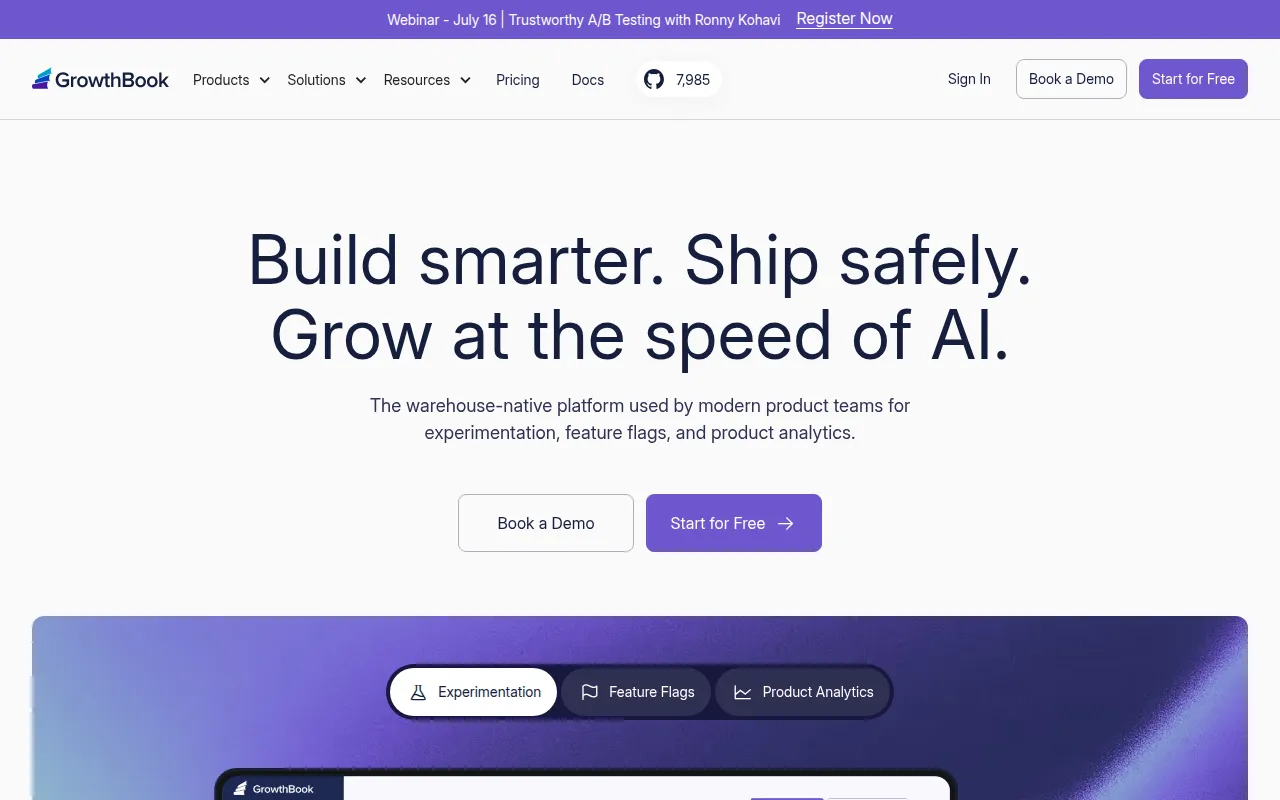
GrowthBook is an open source platform for feature flags, experimentation, and product analytics, built as an alternative to LaunchDarkly and Optimizely for teams that want to run A/B tests against their own data warehouse instead of a vendor's black-box statistics engine. Its stated philosophy is that most companies either overpay for a SaaS experimentation platform or cobble together unmaintained open source libraries, and GrowthBook aims to give any team the flexibility of an in-house platform without building one from scratch.
Key features
- Feature flags: advanced targeting and gradual rollouts tied directly into experiments.
- 24 official SDKs: client libraries for React, Python, Kotlin, Swift, and 20 more languages and platforms.
- Experiment stats engine: supports CUPED, sequential testing, Bayesian and frequentist statistics, post-stratification, bandits, and sample ratio mismatch checks.
- Warehouse-native metrics: query 11 data sources including BigQuery, Snowflake, and Databricks, and define metrics in SQL.
- Built-in product analytics: build dashboards and share experiment results with the team without a separate BI tool.
- Full REST API and webhooks: build custom integrations and workflows around feature flags and experiment results.
- MCP server: create features, start experiments, and clean up stale flags directly from an AI coding agent.
How it works
GrowthBook connects to an existing data warehouse or event pipeline to read exposure and metric data, rather than requiring events to be piped into a separate proprietary datastore first. It computes experiment results with its statistics engine, which supports CUPED, sequential testing, and both Bayesian and frequentist methods, and serves feature flag values to any of its 24 SDKs at runtime with advanced targeting rules.
Ideal use cases
GrowthBook fits data teams that already have an analytics warehouse and want experimentation and feature flagging that reads from it directly, rather than paying for a separate SaaS platform with its own data silo. It suits both engineering teams rolling out features gradually and growth or product teams running statistically rigorous A/B tests.
Self-hosting and deployment
GrowthBook can be self-hosted by cloning the repo and running docker compose up -d, then visiting localhost:3000. The Self-Hosting Instructions in GrowthBook's docs cover configuration beyond the default Docker Compose setup, including connecting an existing data warehouse as a data source. GrowthBook is open core: most of the code is MIT licensed, with some enterprise features under a separate commercial license, and a managed GrowthBook Cloud option is also available for teams that want a hosted instance. New contributors can request a pair programming session with the GrowthBook team through Slack or email to get started with the codebase, and the same Slack community serves as the main real-time support channel for questions and feature discussion, with [email protected] available as a direct email alternative for teams that prefer not to use Slack.
Frequently asked questions




Similar to GrowthBook


