
PostHog
PostHog is an all-in-one platform for product analytics, session replays, feature flags, and experiments.
 Amplitude
 Mixpanel
 Segment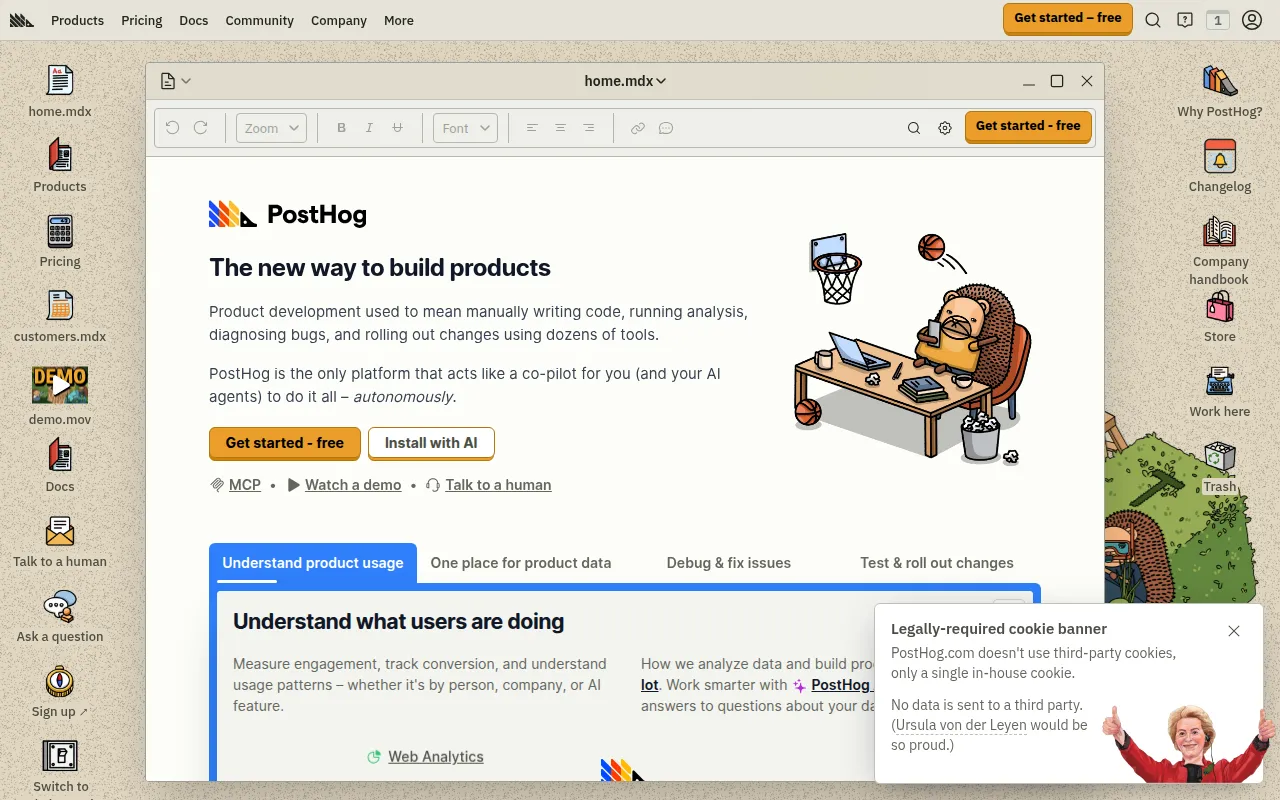
PostHog is an all-in-one, open-source platform for building products, combining product analytics, session replay, feature flags, and experimentation in one system. It's built as an open-source alternative to tools like Mixpanel, Amplitude, and Segment, letting teams instrument events, watch session recordings, and run experiments without wiring together several separate vendors. PostHog can be used as a hosted cloud service or self-hosted on your own infrastructure.
Key features
- Product analytics: Autocapture events or instrument them manually, then analyze behavior with visualizations or raw SQL.
- Session replay: Watch real user sessions on your website or app to diagnose issues and understand behavior.
- Feature flags: Roll out features gradually to specific users or cohorts.
- Experiments: Test changes and measure their statistical impact on goal metrics, including no-code experiment setup.
- Error tracking: Capture errors, get alerted, and track issues through to resolution.
- Data warehouse and pipelines: Sync data from tools like Stripe and HubSpot, query it alongside product data, and send events to 25+ destinations or any webhook.
- AI observability: Capture traces, generations, latency, and cost for LLM-powered features.
Self-hosting and deployment
A hobby self-hosted deployment can be started with a single Docker command: /bin/bash -c "$(curl -fsSL https://raw.githubusercontent.com/posthog/posthog/HEAD/bin/deploy-hobby)", recommended with at least 4GB of memory. Open-source, self-hosted deployments are expected to scale to roughly 100,000 events per month; the project does not provide customer support or uptime guarantees for self-hosted instances and recommends migrating to PostHog Cloud beyond that volume.
Getting started
PostHog ships SDKs for JavaScript, Next.js, React, Vue, React Native, Android, iOS, Flutter, Python, Node, PHP, and Ruby, alongside a browser snippet and a direct API, with additional documentation for Go, .NET/C#, Django, Angular, WordPress, and Webflow. PostHog Cloud includes a free monthly tier covering 1 million events, 5,000 session recordings, 1 million feature flag requests, 100,000 exceptions, and 1,500 survey responses before usage-based billing applies.
Open source and company handbook
PostHog open-sources more than its code. The company also publishes its internal handbook, covering its strategy, ways of working, and team processes, and it maintains a guide to "winning with PostHog" that walks through measuring activation, tracking retention, and capturing revenue once a product is instrumented. Contributions are welcomed through GitHub, and the project distinguishes between its open-source core, free to self-host, and paid features available on PostHog Cloud.
The GitHub repository itself tracks commit activity, closed issues, and contributor counts publicly, which gives a quick read on how actively the project is maintained before committing to it for a production instrumentation stack.
Tags:
Frequently asked questions






Similar to PostHog


