
Anytype
Anytype is a local-first, end-to-end encrypted personal knowledge base for building pages, wikis, and databases with peer-to-peer sync.
 Notion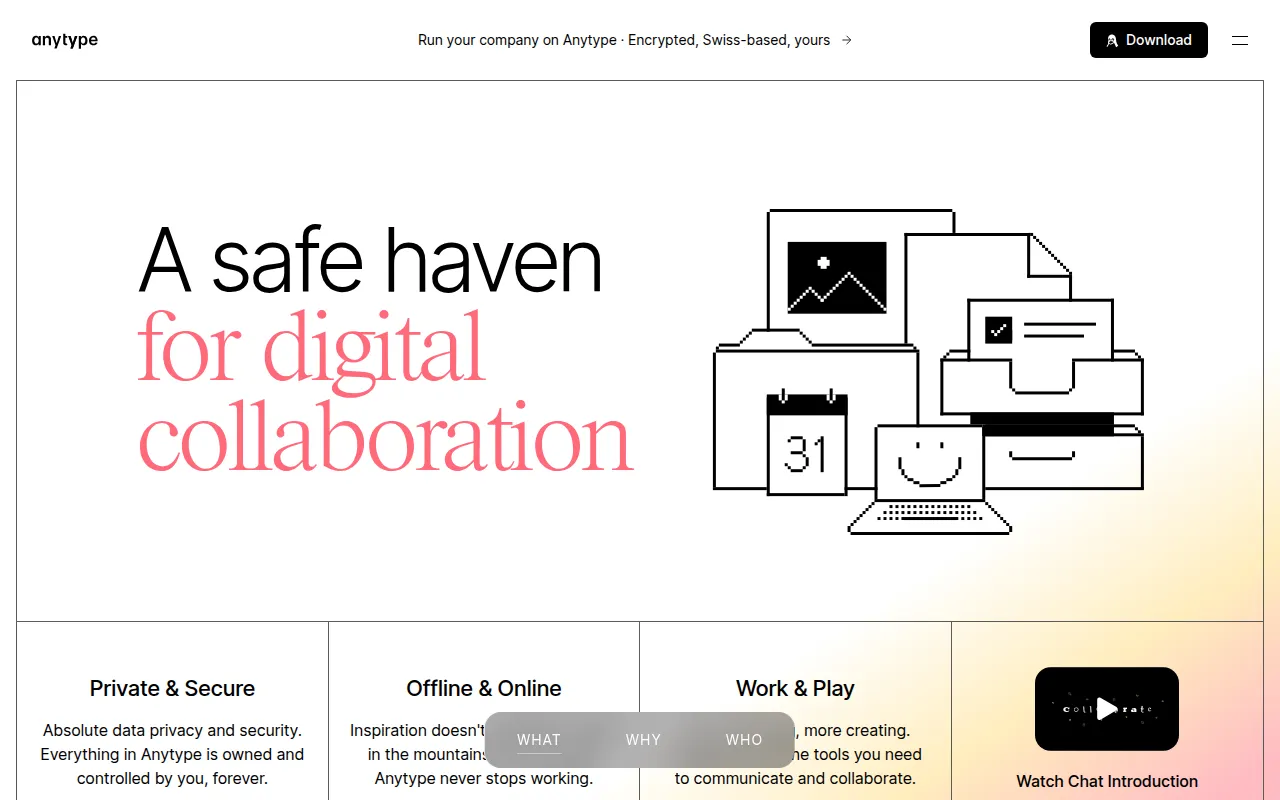
Anytype is a local-first, peer-to-peer, end-to-end encrypted personal knowledge base, commonly positioned as a privacy-focused alternative to Notion. Rather than storing data on a company's servers by default, Anytype keeps information on the user's device and syncs it directly between devices, with zero-knowledge encryption handled by the project's own any-sync layer. The desktop client covers macOS, Windows, and Linux, and is built with Electron and TypeScript, with releases distributed both through GitHub and download.anytype.io.
Key features
- Offline-first local storage: Data is stored on-device first, with optional peer-to-peer sync rather than a mandatory hosted backend controlling access to it.
- Zero-knowledge encryption: The any-sync protocol encrypts data end-to-end, so the sync layer itself cannot read user content even while relaying it between devices.
- Composable blocks and custom Types: Pages combine text, databases, kanban boards, and calendars, and users can define their own data model through custom Types rather than working inside a fixed schema.
- Cross-platform desktop client: A single Electron and TypeScript codebase ships native builds for macOS, Windows, and Linux from one shared source tree.
- Extensible via gRPC API and AI agents: A gRPC API and documented AI "Agents" support extending Anytype programmatically, detailed in the project's AGENTS.md file.
- Web Clipper extension: A browser extension builds for Firefox and Chromium, letting users save web content directly into Anytype without copying and pasting text.
- Community translation: Interface strings are localized through Crowdin, with translation status tracked publicly for the desktop client.
How it works
Anytype's data engine, anytype-heart, is a separate Go-based middleware repository that this TypeScript client depends on; building from source requires fetching a prebuilt middleware binary, or building anytype-heart from source, and generating protobuf bindings before the app will run. Each user authenticates with an Any-ID rather than a traditional account tied to a specific server, which is part of how the project keeps data ownership with the user instead of a central service. The gRPC bindings and generated service registry are git-ignored by design, so a fresh checkout will not build until those generation steps run at least once.
Getting started
Most users install a prebuilt binary from the releases page or download.anytype.io and log in with an Any-ID, without needing to touch the source at all. Developers building from source need Node.js, Bun, a C++ toolchain, Python 3 with setuptools (for rebuilding the keytar package on ARM systems), and, on Linux, the protobuf compiler with the well-known .proto files installed via the distribution's package manager, or a Nix environment that provides all of those dependencies at once. A separate web-mode build lets developers work on the interface in a browser without launching the full Electron shell, which speeds up UI iteration during development.
Frequently asked questions





Similar to Anytype


