
Typesense
Typesense is an open source, typo-tolerant search engine built in C++ for fast, sub-50ms full-text, vector, and hybrid search.
 Algolia
 Elastic
 Pinecone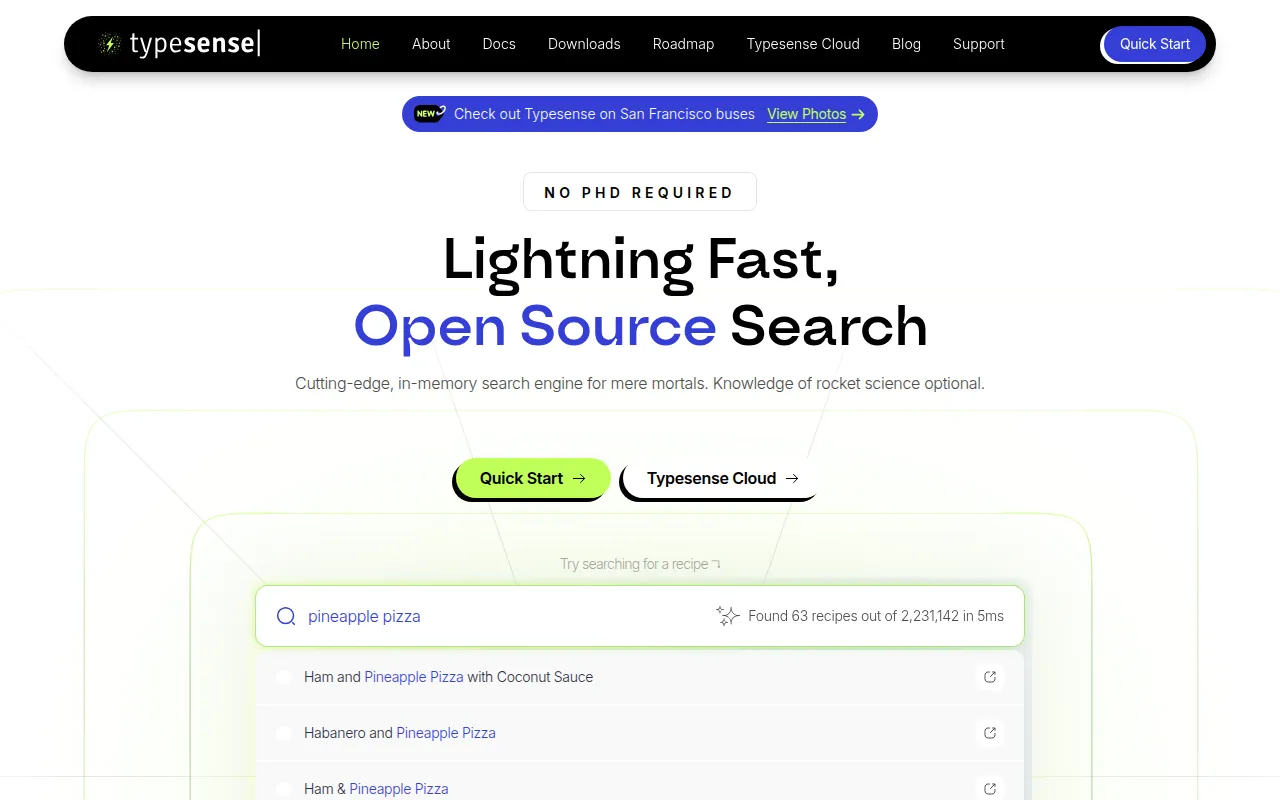
Typesense is an open source search engine built in C++ for speed and simplicity, positioned by its own maintainers as an open source alternative to Algolia and an easier-to-use alternative to Elasticsearch. It runs as a single binary with no runtime dependencies, and serves more than 10 billion searches a month on Typesense Cloud, its hosted offering. Beyond keyword search, it also supports vector search over embeddings, which puts it in the same conversation as vector databases like Pinecone for similarity and semantic search use cases. Typesense's Docker images have been downloaded more than 12 million times, and the project publishes benchmarks against multi-million-record datasets, including handling around 250 concurrent search queries per second on a 3-node cluster indexing 3 million Amazon products.
Key features
- Typo tolerance out of the box: Handles misspellings and typos without extra configuration.
- Sub-50ms search latency: Built in C++ and architected specifically for low-latency instant search.
- Vector and hybrid search: Index embeddings for nearest-neighbor search, or combine keyword and vector search in a single hybrid query.
- Built-in RAG and natural language search: Send questions and get a synthesized sentence-form answer over your indexed data, or convert free-form phrases into structured filters and sorts using LLM-powered query understanding.
- Faceting, geosearch, and JOINs: Drill down with facets and filters, search and sort by geographic distance, and join related collections at query time.
- Federated search: Query multiple collections in a single HTTP request.
- Raft-based clustering: Deploy a highly available distributed cluster rather than a single node.
Self-hosting and deployment
Typesense ships as a single binary with no runtime dependencies, so it can run locally or in production with one command, and Docker images are available with tens of millions of pulls. Upgrades are designed so that swapping the binary and restarting the process is enough to move to a new version, without a separate migration step for most releases. For teams that don't want to operate a cluster themselves, Typesense Cloud offers a managed alternative to self-hosting.
Ideal use cases
Typesense fits products that need instant, typo-tolerant search over structured or semi-structured data, such as e-commerce catalogs, documentation sites, or internal admin tools, without adopting Elasticsearch's operational complexity. The vector and hybrid search support also makes it usable for semantic search and RAG-style question answering, so a single deployment can cover both classic keyword search and embedding-based similarity search. Official API clients and ready-made search UI components cover the common web and mobile stacks, which shortens the path from a running Typesense instance to a working search box in an application. Typesense also maintains a Slack community and community threads forum where usage questions and roadmap discussion happen alongside GitHub issues.
Tags:
Frequently asked questions






Similar to Typesense


