
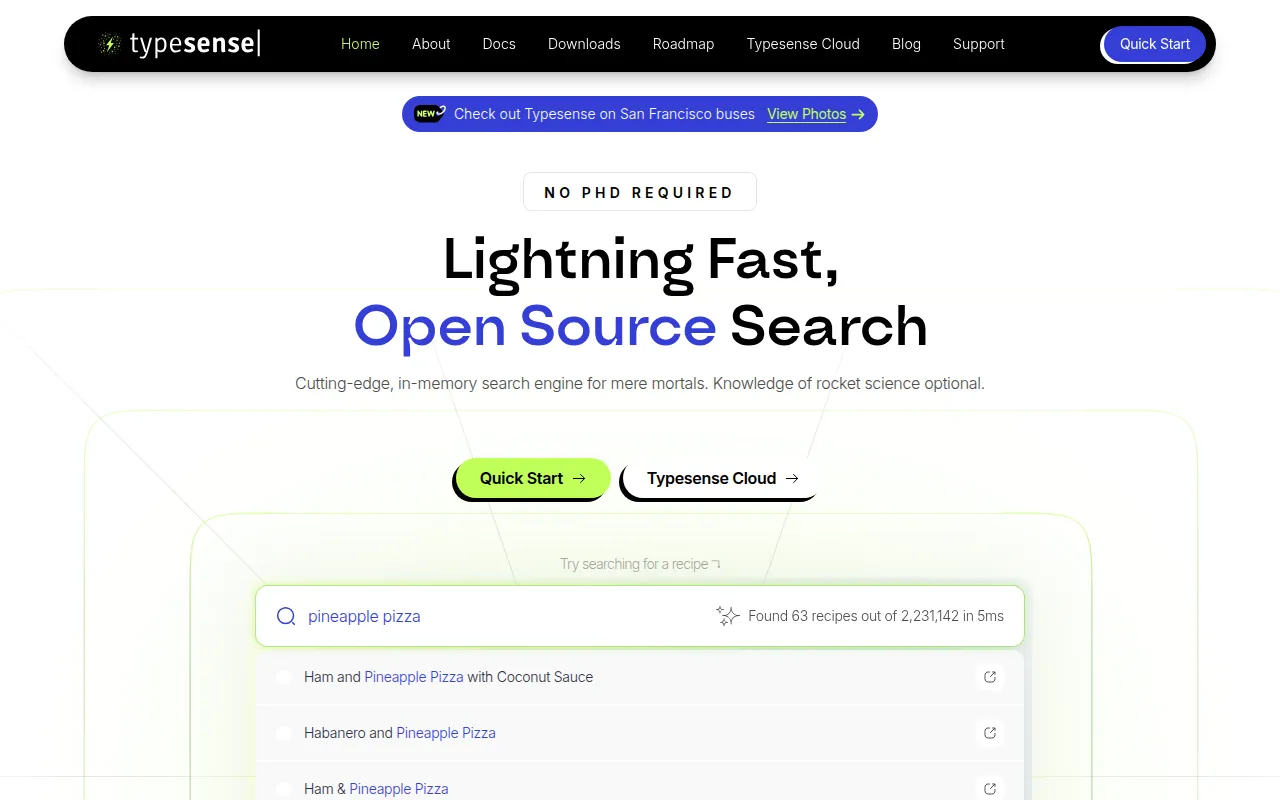
Typesense is an open source, typo-tolerant search engine built in C++ for fast, sub-50ms full-text, vector, and hybrid search.
Read moreThe best open source alternative to Elastic is Typesense. If that doesn't suit you, we've compiled a ranked list of open source Elastic alternatives to help you find a replacement.

Typesense is an open source, typo-tolerant search engine built in C++ for fast, sub-50ms full-text, vector, and hybrid search.
Read moreElastic's flagship product, Elasticsearch, is a distributed search and analytics engine, but the company built a full stack around it: Kibana for visualization, Logstash and Beats for ingestion, and a security and observability layer on top. Running that stack means operating a JVM-based cluster, tuning shard counts, and increasingly paying for features that used to ship free before Elastic changed its license terms. Teams that need fast, user-facing search, not log analytics or a SIEM, often end up managing infrastructure they never use.
For instant, user-facing search (a product catalog, a docs site, an app's search bar), the requirements narrow down to typo tolerance, low query latency, faceting and filtering, and an API simple enough to wire up without a dedicated search team. A general-purpose engine like Elasticsearch can handle all of this, but it is tuned first for large-scale log and text analytics, with search-as-you-type performance as a secondary concern.
Typesense is built specifically for instant search: typo tolerance and relevance ranking work by default rather than requiring configuration, and queries typically return in single-digit to low double-digit milliseconds. It runs as a single binary with no JVM and no cluster of specialized node roles, making self-hosting simpler than standing up an Elastic Stack. Its API and client libraries are modeled closely on Algolia's, so teams moving away from either Algolia or Elastic can test it with limited integration work; the server is GPL-3.0 licensed, with Apache 2.0 client libraries for each language.
Typesense does not cover Kibana-style visualization, Logstash ingestion, or Elastic's observability and security products; it addresses the search layer only. Teams running log aggregation or SIEM workloads still need a purpose-built tool for that job, whether Elastic itself or a project built for logs specifically. For search alone, Typesense's in-memory index and single-binary design keep operational overhead lower than patching and scaling an Elasticsearch cluster.

 Your brand here — Reach our audience of professional directory owners and boost your sales.