
Saleor
Saleor is an open source, GraphQL-native, API-only commerce platform for building composable storefronts and marketplaces.
 BigCommerce
 commercetools
 Shopify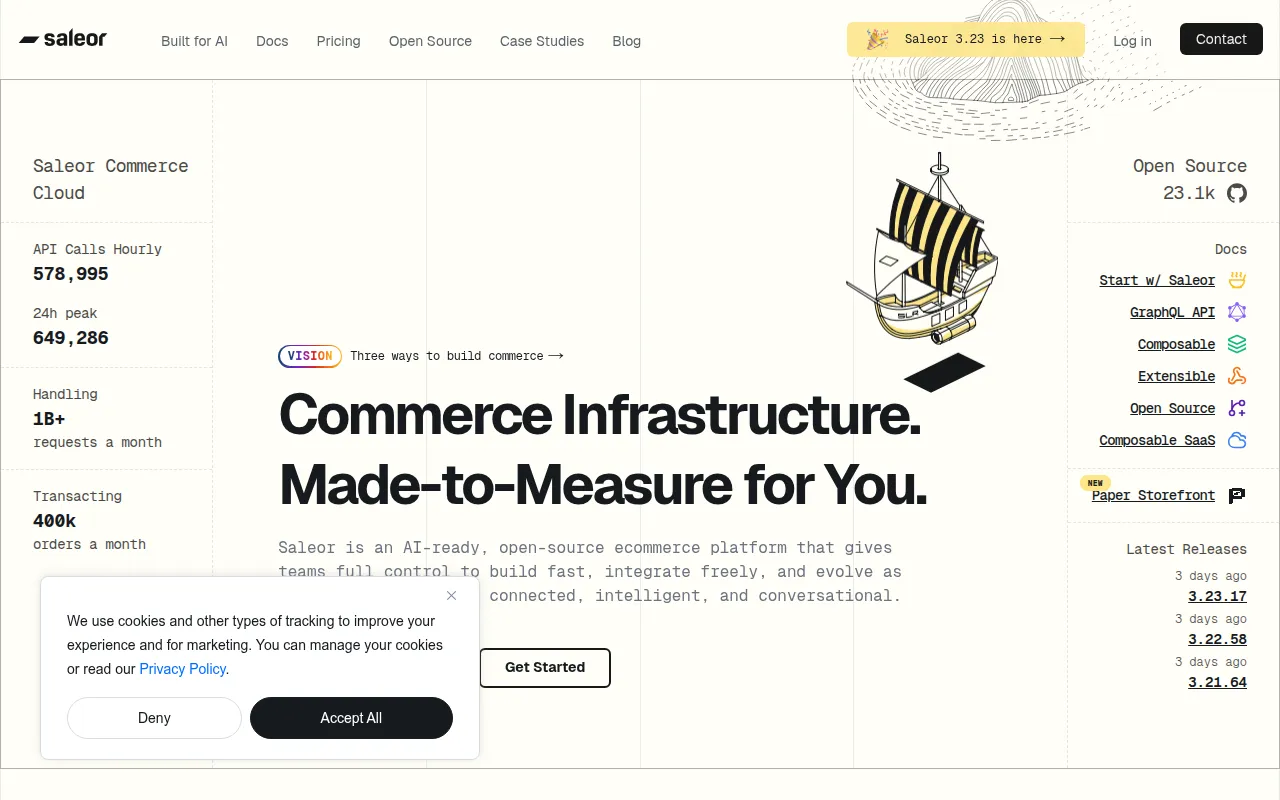
Saleor is a GraphQL-native, API-only commerce platform built for composable storefronts rather than a bundled monolith. Every interaction, configuration, and extension happens through the API, so there's no plugin system tying you to a specific language or framework. It's positioned as an alternative to Shopify, commercetools, and BigCommerce for teams that want control over their storefront stack, and it's described by its maintainers as technology-agnostic by design rather than tied to a single frontend framework.
Key features
- GraphQL-only API: A single, consistent API surface instead of a mix of REST endpoints and plugin hooks.
- Native multichannel: Per-channel control of pricing, currencies, stock, and product data for selling across multiple storefronts or regions.
- Extensible via apps and webhooks: Extend the backend with webhooks, subscription queries, synchronous API extensions, and dashboard iframe apps, all deployed independently of the core.
- Flexible promotion engine: Sales, vouchers, cart rules, and gift cards are built in.
- Payment orchestration: A multi-gateway, extensible payment API supports flexible checkout flows.
- Fully translatable catalog: Multi-language, multi-currency, and multi-warehouse support out of the box.
- Unlimited SEO freedom: The headless architecture leaves URL structure and rendering entirely up to the storefront.
Ideal use cases
Saleor fits teams that deploy frequently and need independent, technology-agnostic extensions, businesses building custom storefronts on any frontend stack, and organizations that have outgrown monolithic e-commerce platforms and need per-channel pricing or multi-warehouse logistics. The maintainers note that a single developer running a low-traffic store may find the service-oriented approach more complex than a traditional framework like WordPress or Magento, so it's best suited to teams with non-trivial scaling or reliability requirements. Because reliability and independent app deployment matter more once several developers are shipping to the same store, Saleor's own documentation frames the tradeoff as favoring teams that already collaborate across multiple services rather than a single monolithic codebase.
Self-hosting and deployment
The saleor-platform repository bundles the API, storefront, and dashboard for running everything locally with Docker Compose. Saleor Cloud offers hosted developer accounts as the fastest way to start, provisioned through the Saleor CLI (saleor register), which can also bootstrap a storefront against a given GraphQL endpoint with a single command. Production deployments should track tagged releases rather than the main branch, which holds in-progress development work and may be unstable. The API, dashboard, and storefront are versioned and released separately, so a production setup pins each of the three components to its own compatible release rather than a single combined version number, and coverage reporting plus linting via Ruff run as part of the project's continuous integration on every change. The project also runs a Discord server and publishes a public roadmap for anyone who wants to see planned work before it lands in a release.
Frequently asked questions





Similar to Saleor


