
Medusa
Medusa is an open source commerce platform with a customizable framework and modules for building online stores and marketplaces.
 Shopify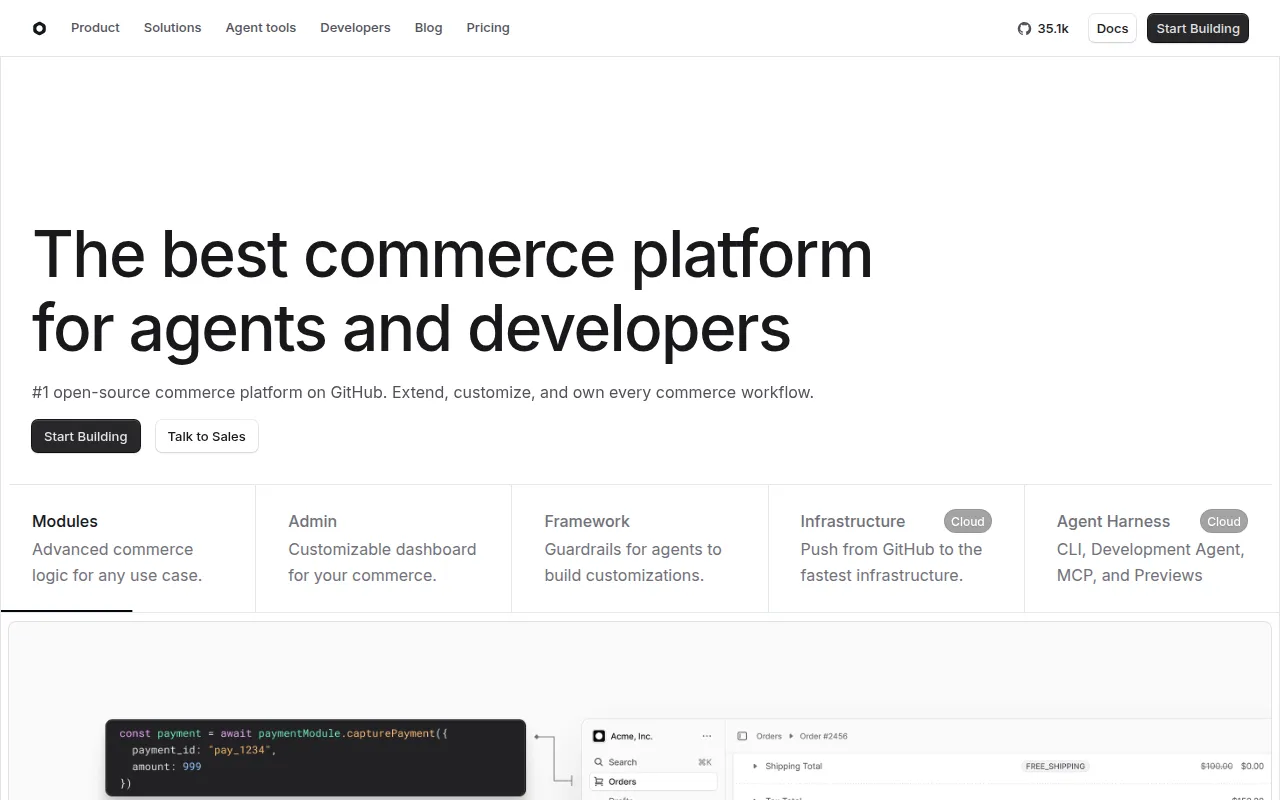
Medusa is an open source commerce platform with a built-in framework for customization, letting teams build commerce applications without reimplementing core commerce logic from scratch. It supports B2B and DTC stores, marketplaces, distributor platforms, point-of-sale systems, and service businesses that need foundational commerce primitives. All commerce modules are open source and published individually on npm, so teams can adopt only the pieces they need rather than a single bundled application. Rather than a fixed storefront template, Medusa treats commerce logic like pricing, inventory, and orders as building blocks that a custom application assembles, which is what its documentation calls "building blocks for digital commerce."
Key features
- Modular commerce architecture: Core commerce logic ships as independent, composable modules rather than a single monolith.
- Framework for customization: Extend or override commerce logic without forking the platform.
- Marketplace-ready: Supports multi-vendor and distributor platform patterns beyond a single-seller store.
- Point-of-sale support: The same commerce primitives can back in-person POS systems, not just web storefronts.
- npm-distributed modules: Commerce modules are published as open source npm packages you can adopt individually.
- Integration ecosystem: A published integrations directory covers payment, shipping, and other commerce services.
- Release-tracked upgrades: Release notes document what changed between versions, so upgrading a self-hosted project is a matter of following a changelog rather than diffing the codebase.
Tech stack
Medusa is written in TypeScript and runs on Node.js. A separate React-based admin dashboard and a Next.js App Router storefront example are maintained as companion repositories, so the API, admin, and storefront can be versioned and deployed independently of one another. Because commerce modules are just npm packages, they can be tested, upgraded, and swapped out individually rather than requiring a full-platform release for every change. A dedicated integrations directory on the Medusa website lists which payment, shipping, and other third-party services already have maintained connectors.
Getting started
Medusa is released under the MIT license, so the core platform and commerce modules carry a permissive license rather than a source-available or dual license. The fastest path is Medusa Cloud, a managed environment with automated deployments and scaling. For a local setup, the documentation at docs.medusajs.com walks through installing the application, connecting a database, and starting the admin dashboard, which lives in its own repository alongside the core platform. The core team stays active in GitHub Discussions for questions, feature ideas, and roadmap conversations, and a Discord server hosts more than 14,000 community members for day-to-day help. Additional channels, including GitHub Issues, Twitter, LinkedIn, and the Medusa Blog, are listed in the repository for teams that want to follow announcements or report bugs outside of Discord. A published contribution guide covers how to work on both the core codebase and the documentation, for teams that want to send fixes upstream rather than only consume releases.
Frequently asked questions







Similar to Medusa


