
Logseq
Logseq is an open-source outliner for notes and tasks, storing data as local Markdown or Org-mode files with backlinks and a plugin API.
 Notion
 Roam Research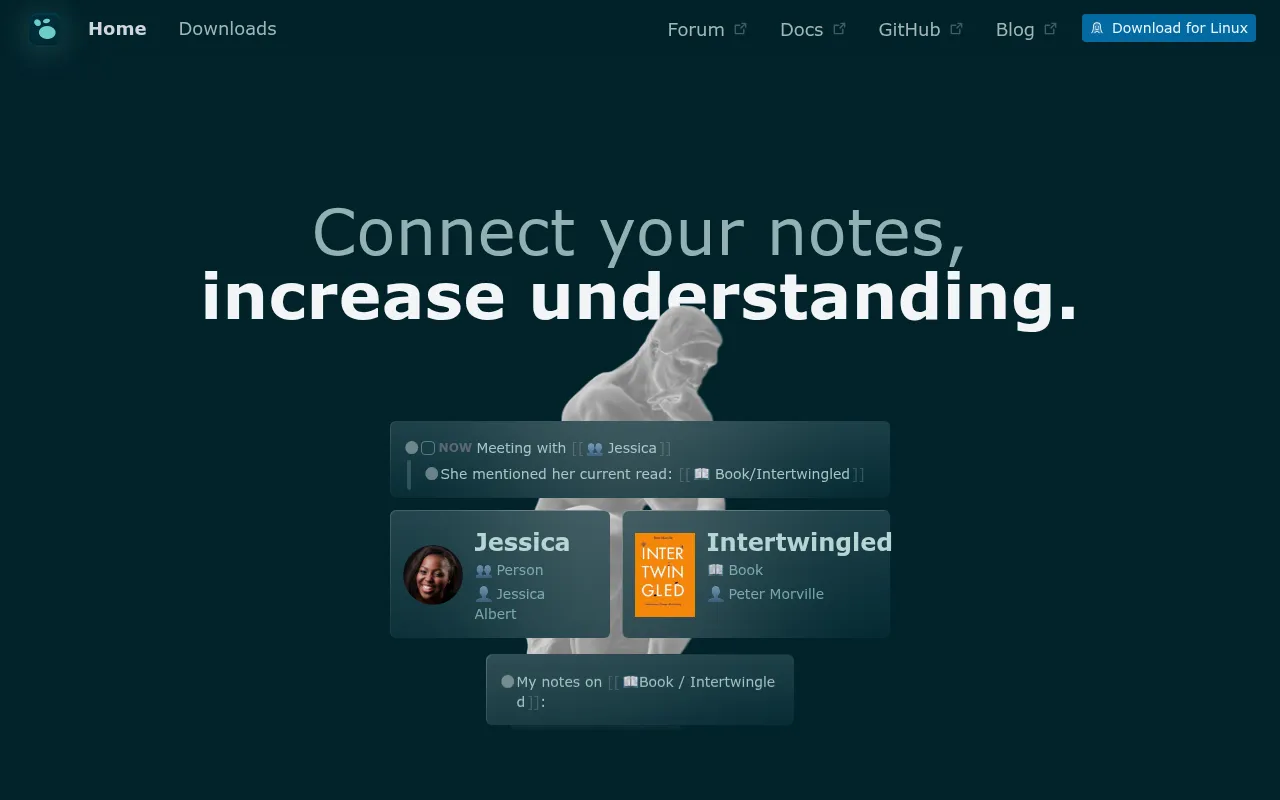
Logseq is a privacy-first, open-source platform for knowledge management and collaboration, built around an outliner-style editor with support for both Markdown and Org-mode files. It's aimed at people who want to keep their notes as plain files under their own control, rather than locked into a proprietary cloud format, while still getting features like backlinks, task management, and PDF annotation. That includes students, researchers, and professionals who want a structured but flexible way to capture and connect their notes.
Key features
- Outliner-based note-taking: notes are structured as nested blocks and pages, making it easy to organize ideas hierarchically.
- File format support: works with both Markdown and Org-mode files, so your notes stay in a format you can read outside the app.
- Privacy-first and local-first: designed around user control of your own data rather than a proprietary cloud backend.
- PDF annotation: annotate PDFs and link those annotations back into your notes.
- Task management: built-in support for tracking tasks alongside your notes, rather than in a separate app.
- Plugin and theme ecosystem: a growing library of community plugins and themes for customizing workflows and appearance, backed by a documented plugin API.
- Mobile apps: apps that carry most of the desktop feature set to phones and tablets.
- Database version (DB graphs): a newer graph-based storage model that adds real-time collaboration (RTC) for syncing and co-editing graphs across devices, alongside a dedicated mobile app for that version.
Ideal use cases
Logseq is a good fit for anyone who wants their notes to remain accessible as local files rather than trapped in a vendor's format. Typical scenarios:
- Daily journaling and task tracking combined in one outliner, where you can link a task back to the project page it belongs to.
- Academic or technical research notes that lean on backlinks to surface related ideas across a growing collection of pages.
- Reading workflows where PDF annotations need to live next to your own commentary and links to other notes.
- Teams or individuals who specifically want Markdown or Org-mode files as the source of truth, so notes remain portable and future-proof.
- Extending the app with plugins for a specific workflow (spaced repetition, custom queries, integrations) rather than waiting for a built-in feature.
It's a weaker fit if you want a polished, feature-complete product with no rough edges. The DB version (the newer database-backed graph model, along with its mobile app and real-time collaboration) is in beta or alpha status, and the project explicitly recommends backups since data loss is possible there. If you need a stable, mature single-file-per-note system today, stick to the file-based version rather than the DB version, and keep regular backups regardless of which you choose.
Installation
The straightforward path is to download a build for your platform:
- Download the latest release of Logseq.
- Install it on your device and launch the app.
- Start writing.
Linux users can use the automated installer script instead of a manual download:
# Download and run the installer
curl -fsSL https://raw.githubusercontent.com/logseq/logseq/master/scripts/install-linux.sh | bash

# Or install a specific version
curl -fsSL https://raw.githubusercontent.com/logseq/logseq/master/scripts/install-linux.sh | bash -s -- 0.10.14

# For user-specific installation (no root required)
curl -fsSL https://raw.githubusercontent.com/logseq/logseq/master/scripts/install-linux.sh | bash -s -- --user
For the newer DB version specifically, you can try the web build at test.logseq.com, or grab a nightly desktop build from the releases page. Two branches matter if you're building from source: test/db tracks stable DB-version releases with fewer bugs and slower updates, while master gets the latest changes faster but with more bugs. If you plan to build from source or contribute code, the project documents setup guides for macOS, Linux, and Windows development environments, plus a Docker-based web app guide and a mobile development guide.
Frequently asked questions





Similar to Logseq


