
Docmost
Docmost is an open source collaborative wiki and documentation platform with real-time editing, diagrams, spaces, and permissions.
 Confluence
 Notion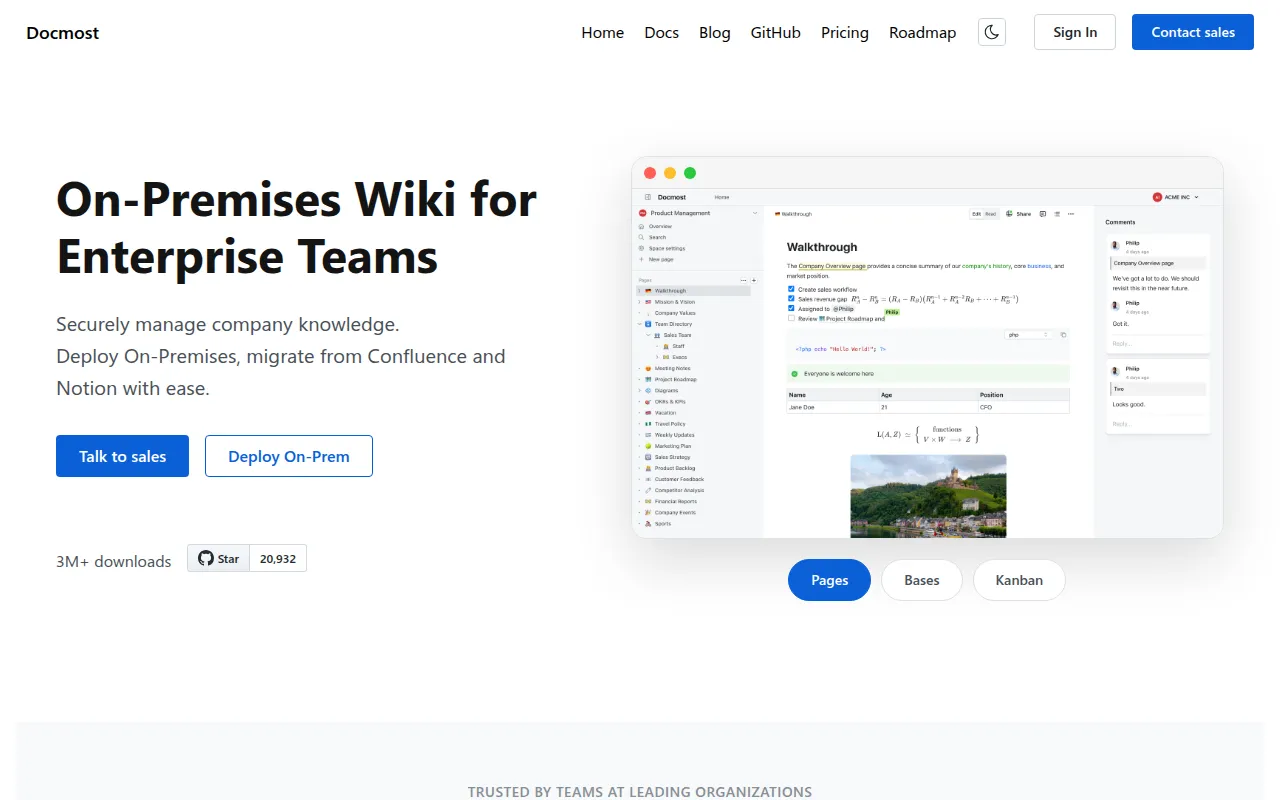
Docmost is an open source collaborative wiki and documentation tool built as an alternative to Confluence and Notion. It supports real-time collaborative editing, structured spaces with permissions, and diagramming, and is available as a self-hosted core product or a managed cloud version. The project keeps its open source core and its enterprise features in clearly separated parts of the codebase rather than gating features behind a single license check scattered throughout. Localization is handled through Crowdin, and the documentation site's search is powered by Algolia, both credited directly in the project's README as supporting infrastructure rather than built in-house, alongside screenshots of the home page and editor shown for anyone evaluating the interface before installing.
Key features
- Real-time collaboration: Multiple people can edit the same page at the same time.
- Built-in diagramming: Create diagrams with Draw.io, Excalidraw, or Mermaid directly inside pages.
- Spaces and permissions: Organize content into spaces with group-based permissions management.
- Page history: Roll back to previous versions of a page.
- Rich embeds: Embed Airtable, Loom, Miro, and other external content inside pages.
- Full-text search: Search across pages and content.
- Comments: Discuss specific pages inline instead of moving feedback to a separate chat tool.
- Multi-language support: The interface is translated into 10+ languages.
Self-hosting and deployment
Docmost core is licensed under AGPL 3.0 and can be self-hosted; setup instructions are in the self-hosting development documentation. Enterprise features live in dedicated ee directories (apps/server/src/ee, apps/client/src/ee, packages/ee) under a separate enterprise license, keeping the open source core and the paid tier clearly separated in the codebase. A managed cloud version is also available for teams that don't want to run their own infrastructure or manage upgrades themselves, and both paths run the same underlying editor and collaboration engine, so the day-to-day experience doesn't change if a team later migrates from self-hosted to cloud or back. Contribution instructions live in the same self-hosting development documentation, so setting up a local instance for evaluation and setting one up to contribute code follow the same starting steps.
Ideal use cases
Docmost fits internal team wikis, product and engineering documentation, and knowledge bases that need diagrams alongside text, as well as teams migrating off Confluence or Notion who want a self-hosted option with comparable collaboration features. Comments and page history make it workable for teams that need review and audit trails on documentation changes, not just a place to dump notes. Groups and space-level permissions also make it suitable for organizations that need to keep some documentation restricted to specific teams while leaving other spaces open company-wide. Multi-language support additionally makes it a reasonable fit for distributed teams that need documentation available in more than one language without maintaining separate wikis per locale.
Frequently asked questions




Similar to Docmost


