
Budibase
Budibase is an open-source platform for building internal tools, AI agents, and business automations.
 Retool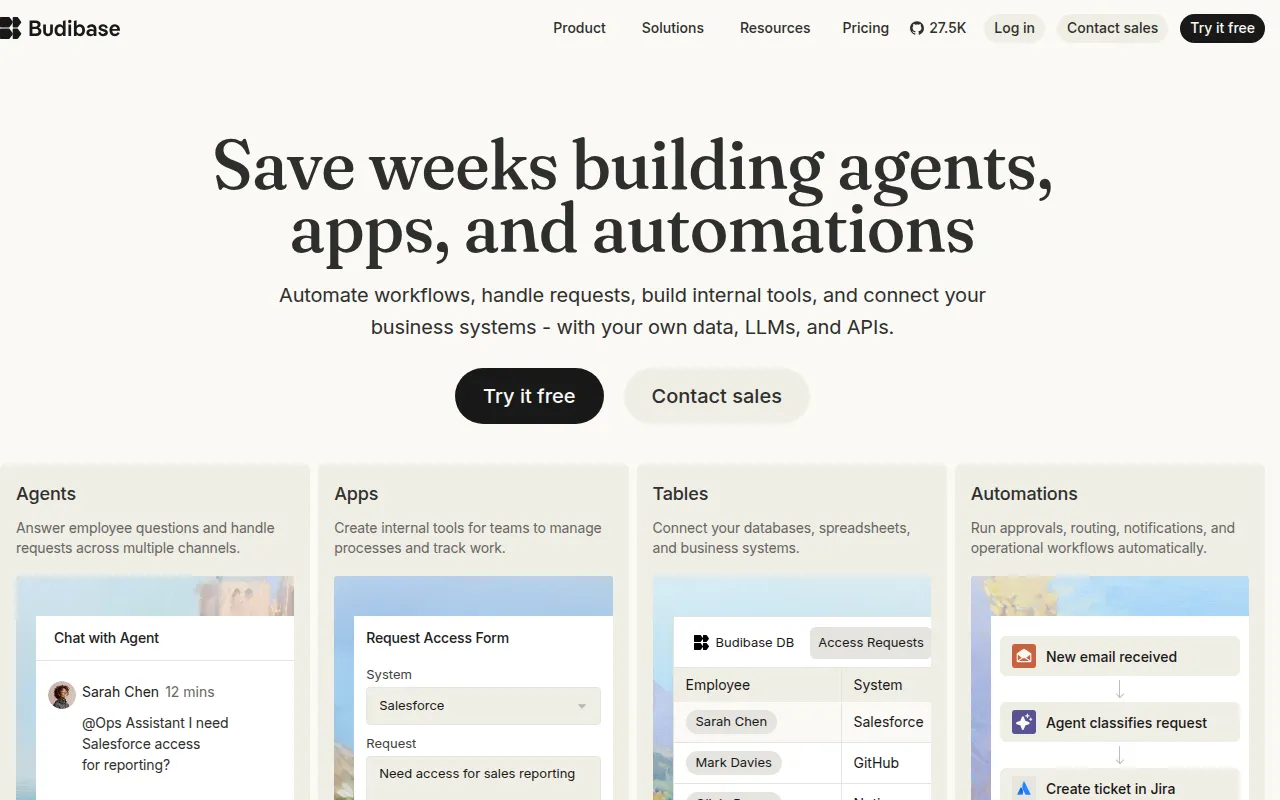
Budibase is an open-source operations platform for building AI agents, internal apps, and automations that connect to a company's existing systems. It's positioned as an open-source alternative to Retool, aimed at engineering teams that need to build internal tools without stitching several products together. Budibase agents can understand employee requests such as approvals or issue reports and carry out the underlying workflow automatically.
Key features
- AI agents for operations: Agents interpret requests like approvals or issue reports and handle the associated work rather than just answering questions.
- Agent actions across systems: Agents create records, route approvals, update apps, and notify teams by taking real actions in connected systems.
- System integrations: Connect databases, AI models, and business apps so agents and automations can act across your existing stack.
- Self-hosted deployment: Run Budibase on your own infrastructure with centralized management of users, groups, onboarding, SMTP, and theming.
- Public API: A documented REST API lets you use Budibase as a backend and integrate it with other systems.
- Low-code app builder: Build internal apps and CRUD tools visually, on top of the same platform that powers the agents.
Self-hosting and deployment
Budibase can be self-hosted with a single ARM-compatible Docker image, Docker Compose, Kubernetes, DigitalOcean, or Portainer, or run as Budibase Cloud if you'd rather not manage infrastructure. The codebase is a monorepo managed with Lerna, split into a Svelte-based builder, a browser client that renders apps from a JSON definition, and a Koa-based server that handles the API and database.
Tech stack
Budibase's core is licensed under GPL v3, with the client and component libraries under MPL so that apps built on top can be licensed however you choose. Paid features are covered by a separate Business Source License.
Codebase and public API
Budibase is a monorepo managed with Lerna. The main packages are packages/builder, a Svelte application for the visual builder; packages/client, a browser module that reads a JSON definition and renders it as a running app; and packages/server, a Koa application that serves the builder, serves running apps, and exposes the API for the database and file system. The public API itself is documented with interactive reference docs and a Postman collection, and is designed so Budibase can act purely as a backend for other systems as well as a full app builder.
Contributing
Budibase follows a Contributor Covenant code of conduct across its community channels, and issues tagged "good first issue" are the suggested starting point for new contributors. Anyone planning a new feature or an API change is asked to open an issue first, so the work is discussed before a pull request is written. GitHub Discussions is the main channel for questions and support outside of formal bug reports.
Tags:
Frequently asked questions







Similar to Budibase

