
BookStack
BookStack is an open source platform for organizing documentation and information into books, chapters, and pages.
 Confluence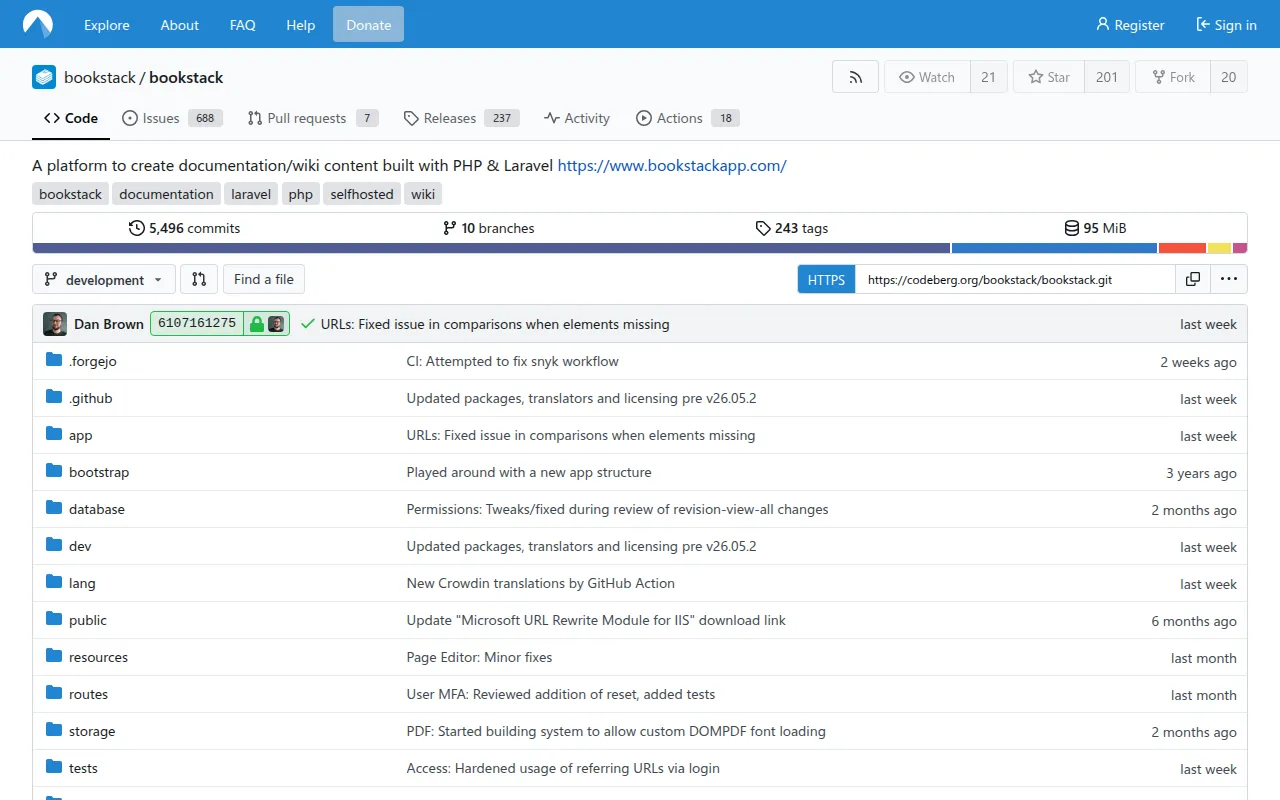
BookStack is an open source, opinionated documentation platform for storing and organizing information into a hierarchy of books, chapters, and pages. It's a common self-hosted alternative to Confluence for teams that want a wiki-style knowledge base without a per-seat commercial license. The project deliberately favors a simple, out-of-the-box experience over being an extensible framework: its own README states BookStack isn't designed to be adapted for purposes beyond documentation. Development follows a relaxed, open approach aimed at slowly and continuously evolving the platform while keeping upgrades stable and easy, and the project publishes its versioning scheme and release process publicly.
Key features
- Book-chapter-page hierarchy: Content is organized into books, optionally split into chapters, then pages, giving structure without requiring a rigid folder tree.
- Built with Laravel/PHP: Runs on a standard PHP/MySQL stack, making it deployable on shared hosting as well as dedicated servers.
- Web installer and updater: A guided installer and updater are included so upgrades don't require manual database migrations from the command line.
- Multilingual via Crowdin: Translations are community-managed through Crowdin, rather than accepted as ad hoc pull requests, to avoid conflicting or stale translations.
- Screen reader support: The interface is built with accessibility in mind, including full screen reader support.
- Customization without forking: A documented "Hacking BookStack" path covers custom CSS, JS, and other extensions without modifying the core source.
Ideal use cases
BookStack fits teams that want a straightforward internal wiki or documentation site and don't need a general-purpose collaboration platform. Its opinionated, book-oriented structure works well for technical documentation, internal knowledge bases, and runbooks where a simple hierarchy is enough, rather than teams that need the broader project-management and integration surface of a tool like Confluence. New users are expected to need only basic word-processing skills to start creating content, while advanced formatting and organization features stay available for power users without getting in the way of that simple default experience.
Self-hosting and deployment
BookStack is a PHP/MySQL application, so it runs on typical LAMP-style hosting as well as containers; official installation instructions are published on the BookStack website, and a live demo instance is available for evaluation before installing. Because it's PHP-based rather than a compiled binary, most hosting providers that already support Laravel applications can run it without specialized infrastructure. Support beyond the documentation is available through community discussions, an issue tracker for bug reports and feature requests, and a project blog covering releases and development updates. The project also publishes screenshots and video walkthroughs on YouTube and PeerTube, giving a preview of the interface and workflow before you commit to an install. Localization status is tracked publicly through a Crowdin badge in the README, so contributors can see at a glance which languages still need translation work.
Frequently asked questions





Similar to BookStack


