
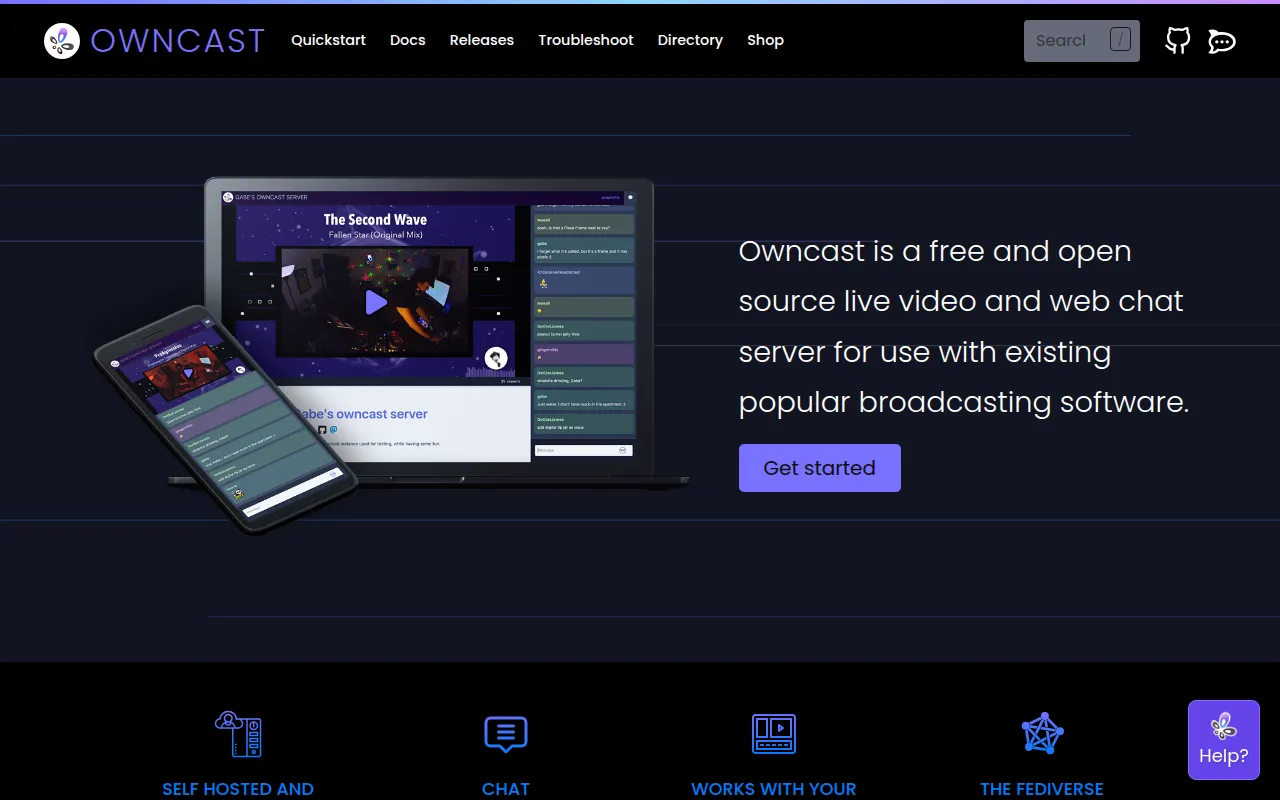
Owncast is an open source, self-hosted live video streaming and chat server that gives you full control over your content.
Read moreThe best open source alternative to Twitch is Owncast. If that doesn't suit you, we've compiled a ranked list of open source Twitch alternatives to help you find a replacement.

Owncast is an open source, self-hosted live video streaming and chat server that gives you full control over your content.
Read moreTwitch is a hosted platform: streaming infrastructure, chat, and audience discovery bundled together, alongside ad breaks the creator doesn't control, a revenue split, and account-level rules that can end a channel without appeal. A self-hosted stream server hands the infrastructure and the monetization, moderation, and data decisions back to the creator, at the cost of losing Twitch's built-in audience and discovery surface.
Replacing the server side of Twitch means running an ingest endpoint (usually RTMP, matching what OBS and similar broadcast software already send), a transcoding step for multiple stream qualities, a web player, and chat. Some self-hosted tools cover only the video pipeline and skip chat or viewer counts entirely, so the full broadcast-to-viewer path needs checking before treating a tool as a complete Twitch replacement.
Owncast runs as a single server that accepts an RTMP stream from OBS or similar software, transcodes it to multiple qualities, and serves a web page with an embedded player and built-in chat, covering the core of what a Twitch viewer experiences. It stores no viewer data beyond what the instance owner configures, and the admin dashboard shows viewer counts, chat moderation tools, and stream health directly, with no third-party analytics layer involved. Page styling and social links are configured per instance, so an Owncast stream looks like its own site rather than a profile page on someone else's platform, and an optional public directory lets instance owners opt into listing themselves for discovery.
Owncast runs on a single server per instance rather than Twitch's globally distributed CDN, so bandwidth and server sizing need to match the expected number of concurrent viewers. It also has no algorithmic recommendation system, so audience growth depends on the creator's own promotion rather than Twitch's browse and discovery pages.

 Your brand here — Reach our audience of professional directory owners and boost your sales.