
Sentry
Sentry is an open source platform for error tracking, performance tracing, session replay, and log management.
 Bugsnag
 Rollbar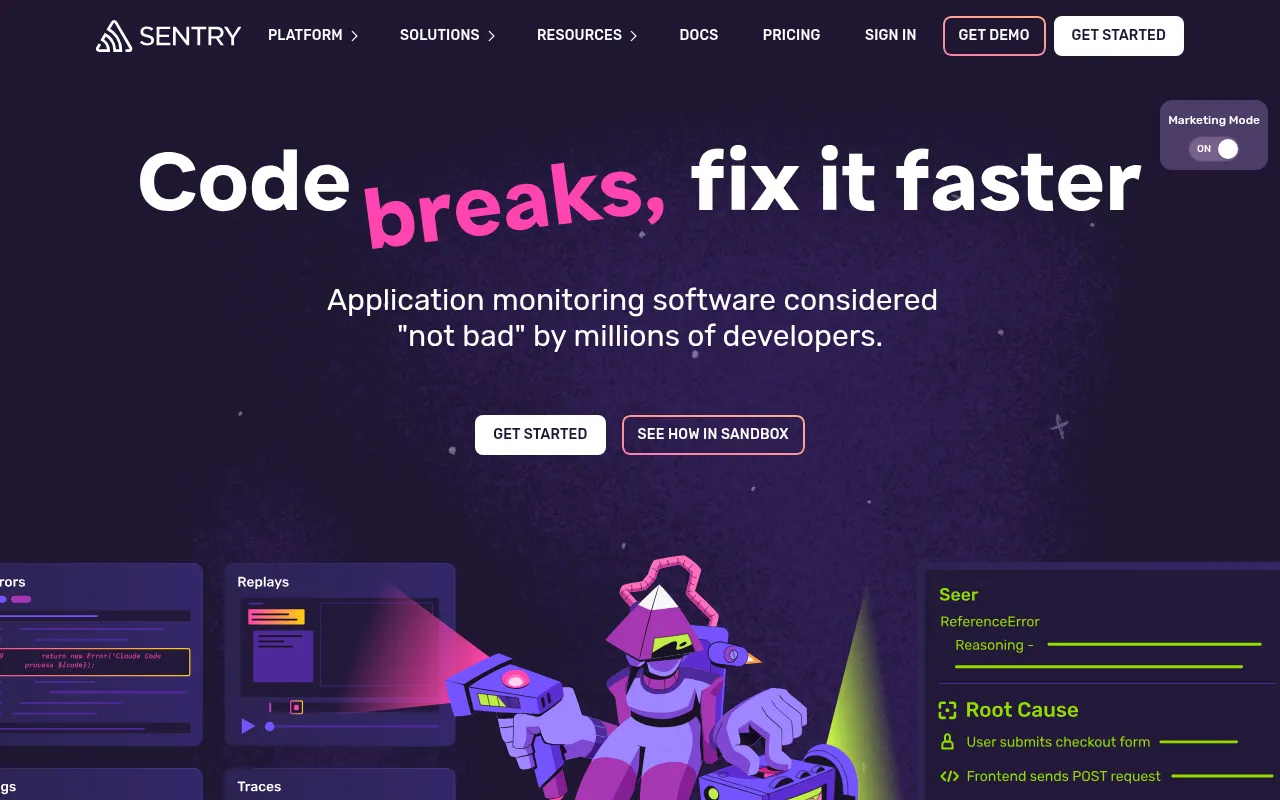
Sentry is an open source debugging platform that helps developers detect, trace, and fix issues in production applications. It combines error tracking, performance tracing, session replay, and log aggregation in one system, giving teams an alternative to piecing together separate tools like Bugsnag or Rollbar for crash reporting alone. Sentry ships official SDKs for more than 20 languages and frameworks, from JavaScript and Python to Rust and Unreal Engine, and includes Seer, an AI-assisted debugging feature that helps investigate issues once they're captured.
Key features
- Issue detail and grouping: errors are automatically grouped into issues with stack traces, breadcrumbs, and the release that introduced them.
- Distributed tracing: follow a request across services to find where latency or failures originate.
- Session replay: watch a recording of the user session leading up to a frontend error.
- Log management: search and correlate application logs alongside traces and errors from the same interface.
- Insights and trace explorer: query performance data across endpoints and database calls to spot regressions.
- Uptime monitoring: track whether external endpoints are reachable and get alerted on downtime.
- AI-assisted debugging with Seer: applies AI analysis to captured issue data to help surface likely root causes and next steps.
Ideal use cases
Sentry fits teams running production applications in any language who need to know when something breaks before a user reports it, and want stack traces tied to the exact release and commit that caused the issue. It's used across web frontends, backend services, mobile apps, and game engines, given the breadth of its official SDKs, which cover everything from React Native and Flutter to Unity, Unreal Engine, and Godot. Teams already paying for a narrower crash-reporting tool like Bugsnag or Rollbar typically adopt Sentry to consolidate crash reporting, tracing, and logs under one dashboard instead of stitching several vendors together.
How it works
When an SDK is installed in an application, it captures unhandled exceptions, performance spans, and, optionally, session replays and logs, then sends them to a Sentry instance. Events are ingested through Kafka, stored in ClickHouse for fast large-scale queries, and grouped into issues so a stack trace only needs to be triaged once no matter how many times it recurs. Alerts route qualifying issues to tools like Slack or a ticketing system based on rules a team defines.
Tech stack
Sentry's backend is written in Python, with a large TypeScript and React frontend for the dashboard. It relies on Kafka, ClickHouse, and Postgres for ingesting and querying large volumes of event data at scale. Beyond the codebase, Sentry maintains an active GitHub Discussions board, a Discord server, and a Transifex project for translating the product into other languages, alongside a public bug tracker for issues in the open source repository.
Frequently asked questions





Similar to Sentry


