
Plausible
Plausible Analytics is an open source, privacy-first web analytics tool built as a lightweight, cookie-free Google Analytics alternative.
 Google Analytics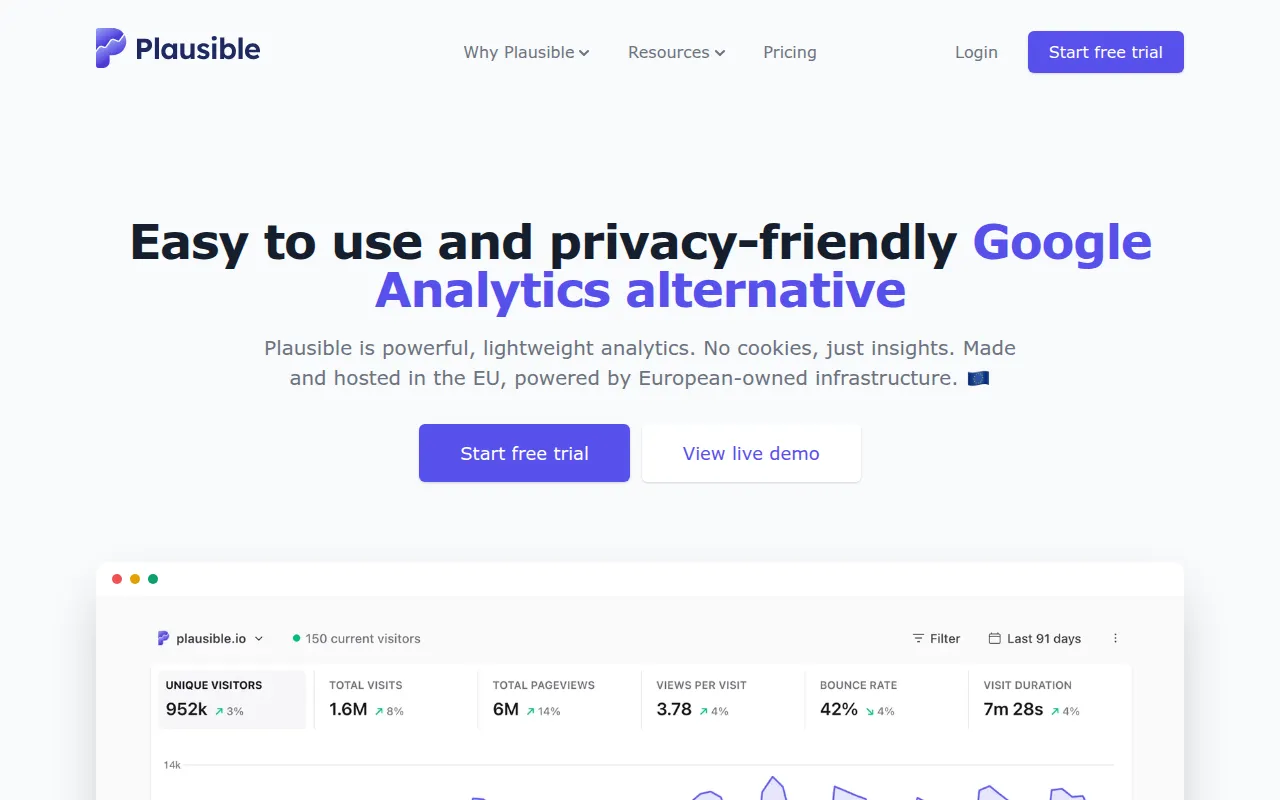
Plausible Analytics is an open source, privacy-first web analytics tool positioned as a lightweight, cookie-free alternative to Google Analytics. It's available as a managed cloud service or as a free, self-hosted Community Edition, and the dashboard fits key metrics on a single page instead of spreading them across menus and custom reports. The project is independent and funded entirely by subscribers rather than by monetizing visitor data. Its stated mission is reducing corporate surveillance in web analytics by offering a tool that doesn't come out of the AdTech world, and that positioning shapes both the product's data model and its subscription-only business model.
Key features
- Cookie-free tracking: No cookies or persistent identifiers are used, and no personal data or IP addresses are stored.
- Compliance by design: Built to be GDPR, CCPA, and PECR compliant without a cookie consent banner.
- Lightweight script: The tracking script is small enough that it doesn't noticeably slow page loads.
- Goals and funnels: Track conversions, revenue attribution, and funnels using custom events and dimensions.
- Codeless event tracking: Turn on tracking for outbound clicks, form completions, file downloads, and 404 pages without adding code.
- Search Console integration: Pulls keyword data from Google Search Console directly into the dashboard.
- Team sharing: Share dashboards publicly or with specific people, and get scheduled email or Slack reports.
Self-hosting and deployment
Plausible Community Edition (CE) is free and self-hosted, released as a long-term release twice a year rather than the continuous updates the managed cloud gets. Self-hosting means managing your own server, database, backups, and uptime, and it excludes some premium features like marketing funnels, ecommerce revenue goals, SSO, and the sites API. The managed cloud service runs exclusively on EU-owned infrastructure in Germany, keeping site data inside the EU for GDPR and Schrems II compliance. Cloud customers also get advanced bot filtering that excludes roughly 32,000 data center IP ranges by default, while CE ships a more basic filter based on the User-Agent header and known referrer spam domains.
Tech stack
The backend is written in Elixir on the Phoenix framework, with ClickHouse used for storing and querying analytics events. Historical data from Google Analytics can be imported so teams switching over don't lose their trend history. Sites can also send events directly to Plausible's events API, which makes it possible to build custom tracking on top of the same backend instead of relying solely on the bundled script. The tracking script also works with modern single-page app routing out of the box, including both pushState-based navigation and hash-based routing, without extra configuration for either pattern. A live demo running on plausible.io's own traffic is publicly viewable, so the dashboard can be evaluated before signing up or self-hosting.
Tags:
Frequently asked questions






Similar to Plausible


