
Penpot
Penpot is an open source, self-hostable design and prototyping platform built on open web standards like SVG and CSS.
 Figma
Figma Sketch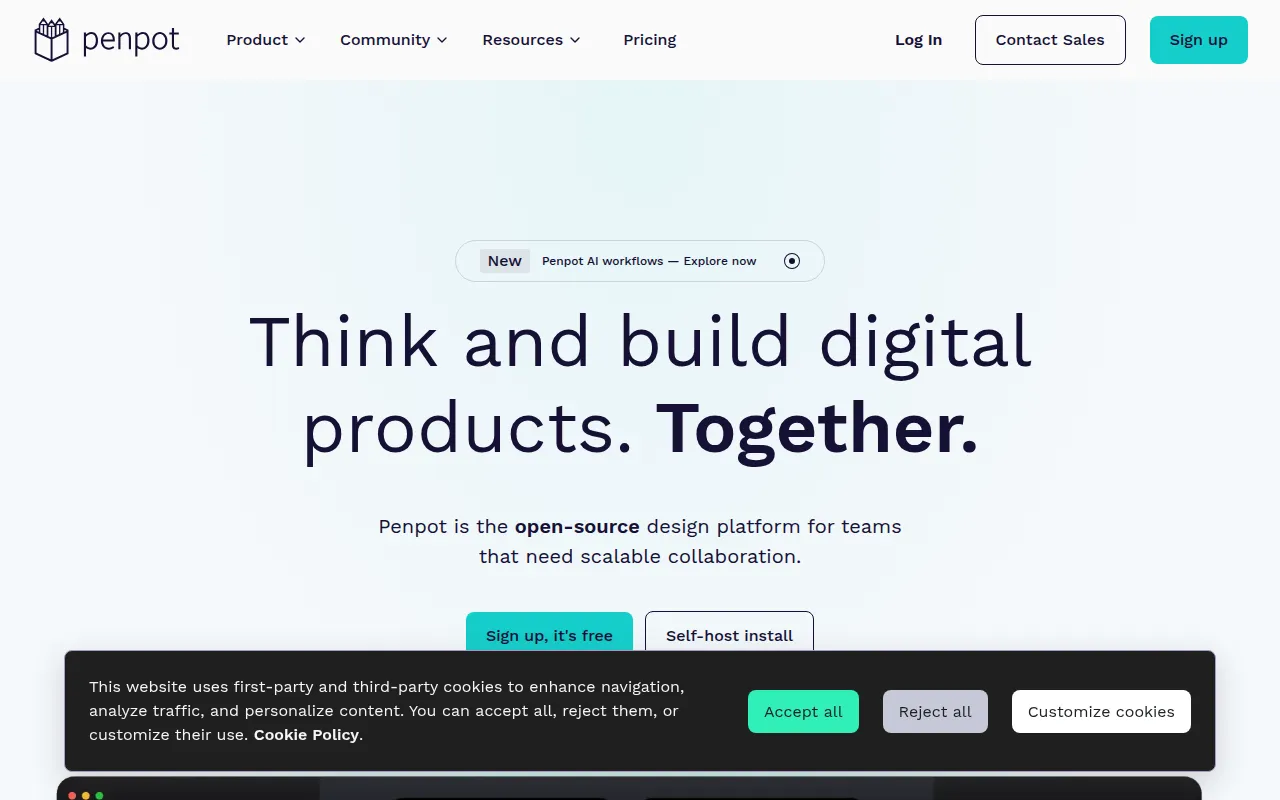
Penpot is an open source design and prototyping platform built for teams that want to own their design infrastructure instead of relying on a proprietary tool like Figma or Sketch. It runs in the browser as a hosted service or self-hosted on your own servers, and it works with open standards such as SVG, CSS, HTML, and JSON rather than a proprietary file format. Real-time collaboration lets multiple designers work in the same file at once, while developers get direct access to inspectable code instead of a static handoff.
Key features
- Real-time collaboration: multiple designers work on the same file simultaneously, similar to collaborative editors like Figma.
- CSS Grid and Flex Layout: build responsive interfaces using layout primitives that map directly to how browsers render CSS, so designs behave like real code from the start.
- Native design tokens: define a single source of truth for colors, spacing, and typography that syncs between design and development, useful for managing complex design systems consistently.
- Components and variants: build reusable components with variants for scalable, consistent UI across projects and platforms.
- Inspect mode: every element exposes ready-to-use SVG, CSS, and HTML code, so developers can hand off designs without a separate tool.
- Plugin system and MCP server: extend the workspace with plugins, or connect it to AI coding agents through Penpot's MCP server for multi-directional design-to-code workflows.
- Deployment-agnostic: use the hosted SaaS at design.penpot.app or self-host with Docker, Kubernetes, or Elestio.
Ideal use cases
Penpot suits design and product teams that need strict data governance or compliance and can't put design files on a third-party server, as well as teams that want designers and developers working from the same artifact instead of handing off static mockups. Since it's built on open web standards, it also fits teams that want to script or automate parts of their design workflow through the API or plugin system. Organizations already investing in design systems benefit from Penpot's native design tokens, which keep colors, spacing, and typography synchronized between Penpot and the codebase that consumes them. Penpot also supports webhooks and access-token-based API integration for wiring the design workspace into a broader development toolchain.
Self-hosting and deployment
Penpot can be self-hosted with Docker, Kubernetes, or through managed platforms like Elestio, giving teams full control over where design data lives. The same codebase also runs as a hosted SaaS product at design.penpot.app, so teams can start on the cloud version and migrate to self-hosting later without changing tools. Penpot is recognized as a Digital Public Good, and the project runs a community forum, an Ambassador Program for regional community building, and channels on Mastodon, Bluesky, and YouTube for support and updates.
Tags:
Frequently asked questions







Similar to Penpot


