
Mautic
Mautic is an open source marketing automation platform for email campaigns, segmentation, and multi-channel workflows.
 HubSpot
 Marketo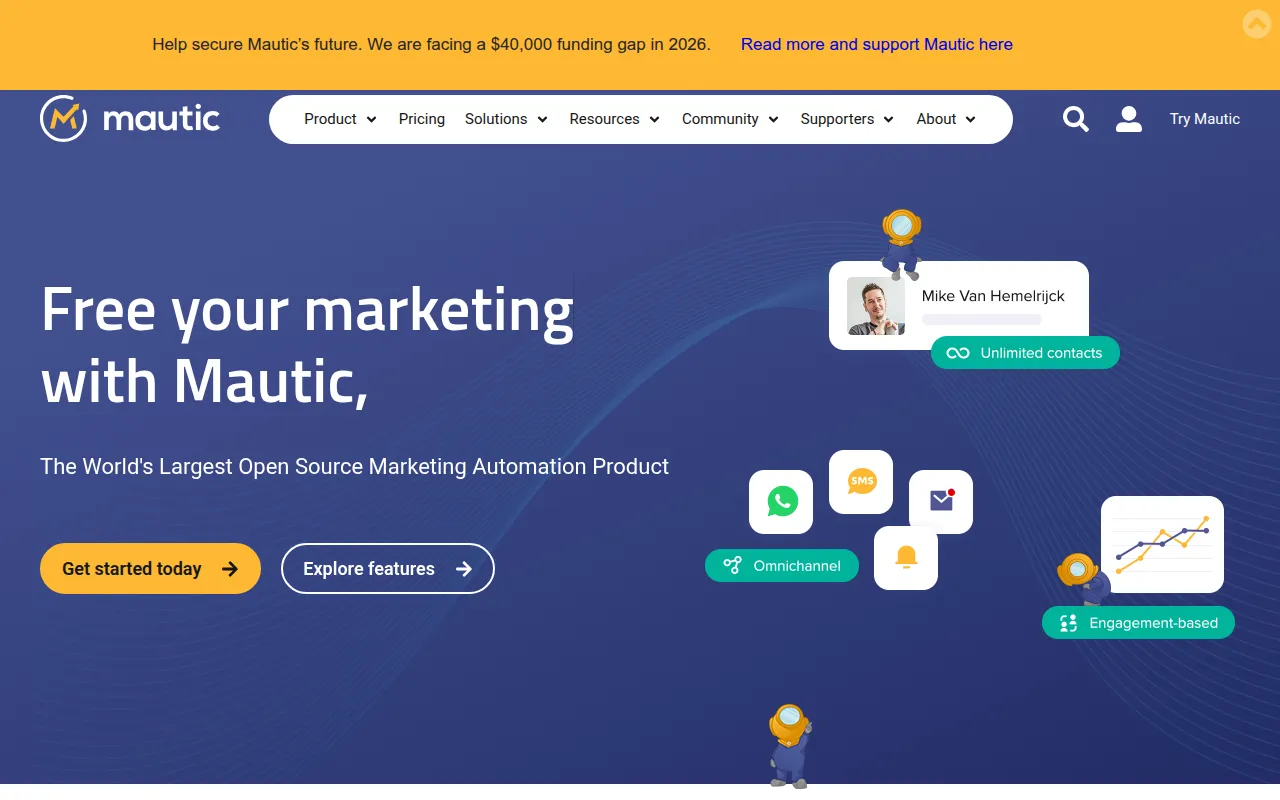
Mautic describes itself as the world's largest open source marketing automation project, giving teams the campaign building, segmentation, and email automation tooling normally found in commercial platforms like HubSpot and Marketo, without the SaaS subscription. Because Mautic runs on infrastructure you control, campaign and contact data stays in your own database rather than a third-party vendor's. The project frames its focus as being the most privacy-focused, accessible, and extendable marketing automation product on the market. It has been a verified Digital Public Good since 2024, and support runs through GitHub Issues, a community forum, and user and developer documentation sites. Mautic also maintains a public analytics dashboard of contribution activity and follows a documented code of conduct governing how the project and its community operate.
Key features
- No per-contact or per-send pricing: Self-hosting removes the tiered contact-count and send-volume pricing common to hosted marketing automation platforms.
- Own your data: Campaign, contact, and engagement data live in your own database rather than a vendor's, with no vendor lock-in.
- Unlimited segmentation and automation: Build audience segments and automated campaigns without artificial feature or volume caps.
- Fully customizable frontend and backend: Both the customer-facing pages and backend logic are described as 100% customizable.
- Build any integration you need: Custom integrations can be built directly rather than waiting on a vendor's marketplace.
- Multi-channel marketing: Runs campaigns across multiple channels without additional per-channel costs.
Getting started
Mautic recommends installing via Composer for production, following the documented command-line install process; a zip-based install is also supported by downloading the repository, running composer install, and completing setup through the web installer. For local development, a DDEV configuration ships in the repo, so ddev start (or ddev config then ddev start) bootstraps dependencies and configuration automatically. A hosted trial is also available directly from Mautic's website for evaluating the product before self-hosting it.
Ideal use cases
Mautic fits organizations that want marketing automation, mostly email-driven campaigns, lead scoring, and segmentation, without recurring per-contact SaaS fees or a vendor holding their contact data. It suits privacy-conscious teams and nonprofits that need to control where marketing data is stored, as well as developers who want to build custom integrations rather than rely on a fixed app marketplace. The project also welcomes new contributors directly, tagging easy-to-fix bugs and low-code or no-code tasks so people can start contributing without deep Mautic experience. Security issues can be reported through a dedicated advisory form rather than a public issue, and the project documents supported PHP and database versions so operators can plan upgrades ahead of end-of-life dates. Mautic also publishes a documented supported-versions and requirements page, so admins running a self-hosted instance know which PHP and Mautic releases are current before upgrading.
Tags:
Frequently asked questions






Similar to Mautic


