
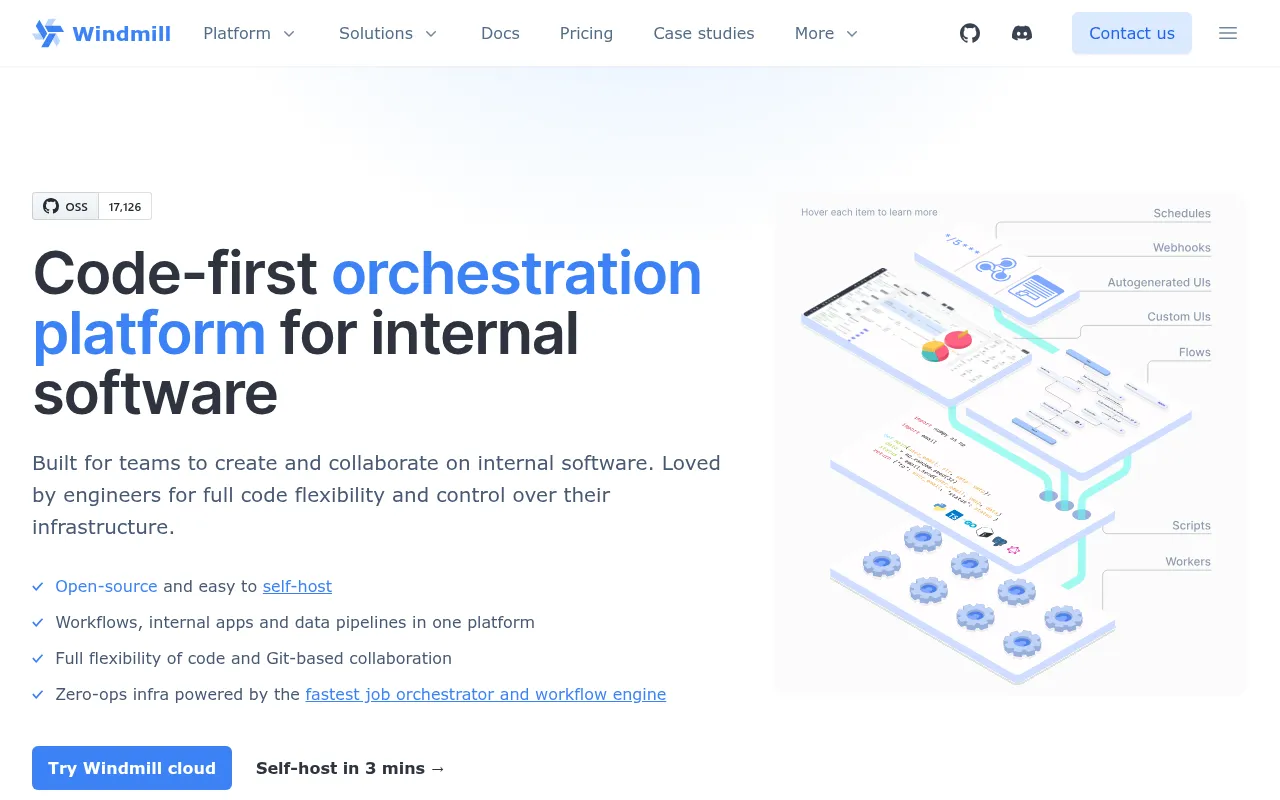
Windmill is an open source platform that turns scripts into APIs, workflows, and internal UIs with auto-generated frontends.
Read moreThe best open source alternative to Temporal is Windmill. If that doesn't suit you, we've compiled a ranked list of open source Temporal alternatives to help you find a replacement.

Windmill is an open source platform that turns scripts into APIs, workflows, and internal UIs with auto-generated frontends.
Read moreTemporal's durable execution model is powerful but comes with real operational weight: running a Temporal cluster means managing its own database, such as Cassandra, Postgres, or MySQL, the Temporal server, and writing workflows as code in one of its supported SDKs. For teams that need reliable scheduled and event-driven workflows without that operational surface, a lighter open-source workflow platform can cover a large share of the same use cases, retryable steps, scheduled jobs, background automation, with a much simpler deployment.
Cost and hosting control matter here too. Temporal Cloud bills based on usage, and self-hosting Temporal requires dedicated infrastructure expertise. An alternative with a smaller footprint can run on a single server for smaller workloads, only scaling out infrastructure once the workflow volume actually requires it.
A workflow orchestration alternative needs retries and error handling per step, a way to compose multi-step flows visually or as code, scheduling with cron-style triggers, and observability into running and past executions. If workflows also double as internal tooling or scripts, built-in support for writing steps in multiple languages such as Python, TypeScript, and Bash without a heavy SDK is worth checking for.
Windmill is an open-source platform for scripts, workflows, and internal tools, built with a visual flow editor alongside a code-first scripting model in Python, TypeScript, Go, and Bash. Workflows in Windmill are defined as a sequence of steps with built-in retries, error handling, and scheduling, covering much of the same durable-workflow use case as Temporal but with a lower barrier to entry: no separate workflow SDK to learn, and a single self-hosted deployment via Docker Compose or Kubernetes rather than a dedicated cluster and database. Windmill also includes an app builder for turning scripts into internal UIs, extending its use case beyond pure workflow orchestration. For teams whose Temporal usage is closer to running a multi-step job reliably on a schedule than to Temporal's more advanced durable-execution guarantees, Windmill covers that need with substantially less infrastructure.

 Your brand here — Reach our audience of professional directory owners and boost your sales.