
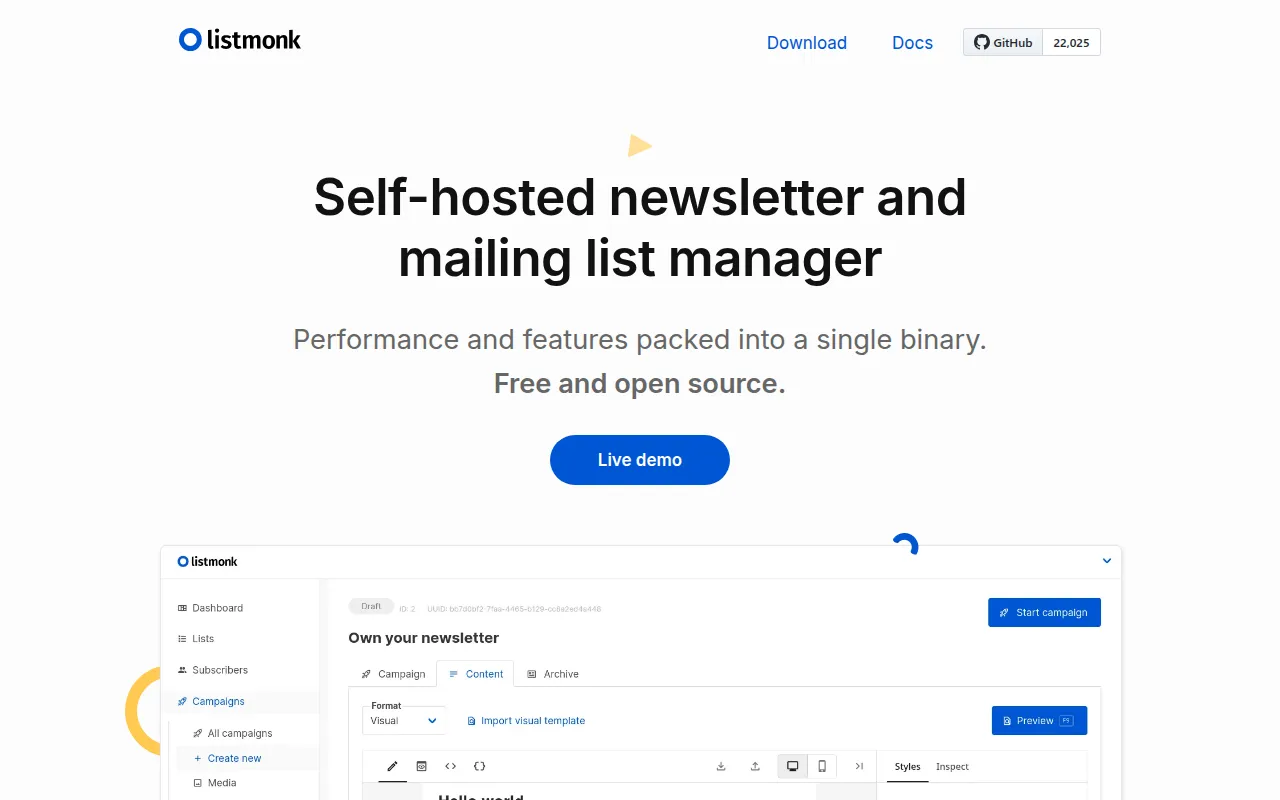
listmonk is a self-hosted, single-binary newsletter and mailing list manager backed by PostgreSQL.
Read moreThe best open source alternative to Mailchimp is listmonk. If that doesn't suit you, we've compiled a ranked list of open source Mailchimp alternatives to help you find a replacement.

listmonk is a self-hosted, single-binary newsletter and mailing list manager backed by PostgreSQL.
Read moreMailchimp's pricing scales with the number of contacts on a list, so costs climb as an audience grows even if send volume stays flat, and inactive or unsubscribed contacts can still count toward the limit depending on plan settings. Self-hosting a mailing list manager removes that per-subscriber fee structure and keeps subscriber data off a third-party platform, which matters for teams with strict data residency or privacy requirements.
A Mailchimp alternative needs list and segment management, a campaign editor with both rich text and raw HTML modes, bounce and complaint handling so sender reputation stays clean, SMTP relay flexibility so sending is not tied to one vendor, and reporting on opens, clicks, and unsubscribes. For a self-hosted tool, ease of deployment and database requirements matter as much as feature parity, since the team running it also maintains it and handles its own deliverability setup.
listmonk is a self-hosted newsletter and mailing list manager written in Go, distributed as a single binary that runs against a Postgres database, which makes deployment on a small VPS straightforward. It handles multiple lists, subscriber import and export via CSV, campaign scheduling, and bounce processing, and it can send through any SMTP provider or transactional service such as Amazon SES or Postal. The campaign editor supports rich text, plain text, and raw HTML, with Go templating for personalization and support for multiple languages in the admin interface. Because it has no built-in subscriber cap or per-contact charge, an installation can hold hundreds of thousands of subscribers on infrastructure the team already controls. Analytics cover opens, clicks, and per-campaign bounce rates, and public subscription forms can be embedded on an existing website to grow a list without a third-party signup widget.

 Your brand here — Reach our audience of professional directory owners and boost your sales.