
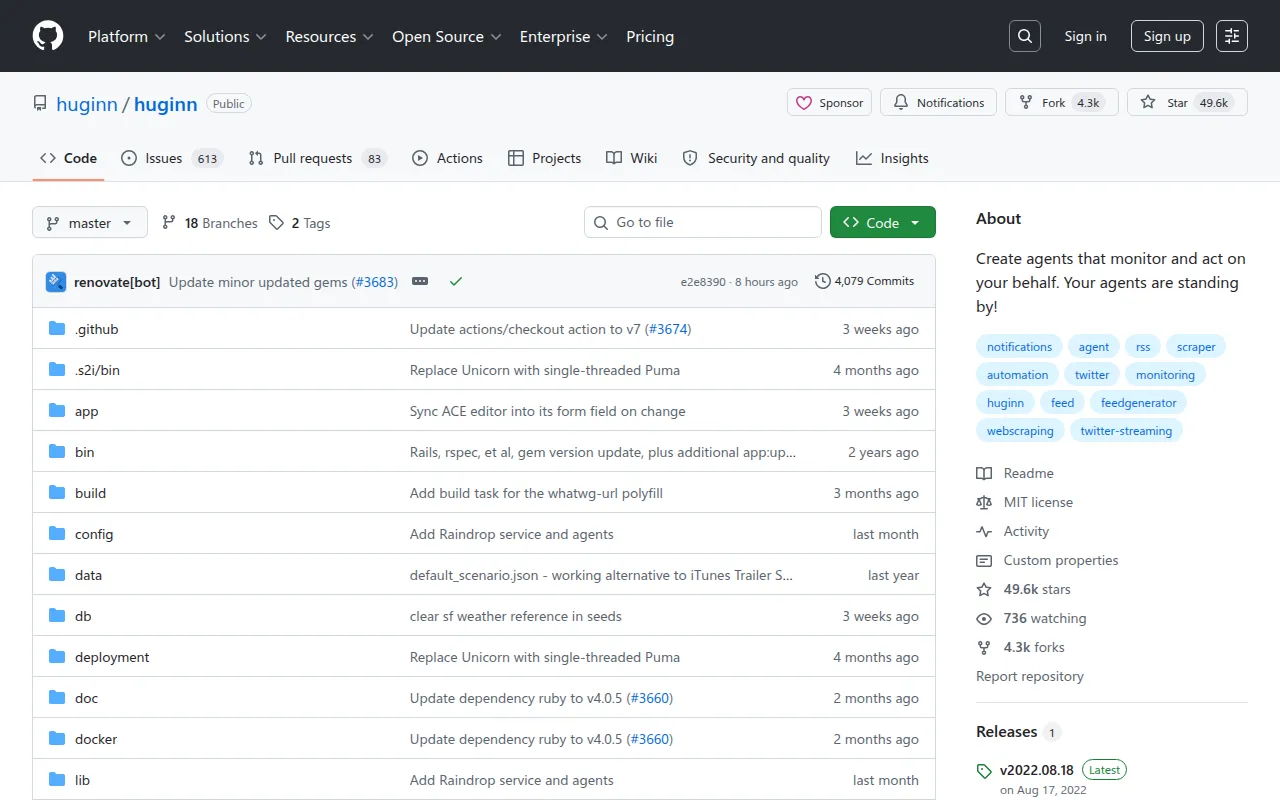
Huginn is a self-hosted Ruby system for building agents that watch feeds, scrape sites, and trigger automated actions on your data.
Read moreThe best open source alternative to IFTTT is Huginn. If that doesn't suit you, we've compiled a ranked list of open source IFTTT alternatives to help you find a replacement.

Huginn is a self-hosted Ruby system for building agents that watch feeds, scrape sites, and trigger automated actions on your data.
Read moreIFTTT connects consumer apps and services through pre-built "applets," running entirely on IFTTT's servers with limits on how many applets a free account can run and how often they check for triggers. Huginn replaces that model with agents that run on infrastructure the user controls, each one a small worker process with a defined job, chained together to build workflows IFTTT's applet format can't express.
A serious IFTTT or Zapier replacement needs multi-step logic, not just a single trigger-then-action pair, conditional branching between steps, and the ability to shape or filter data as it passes from one step to the next. It also needs enough built-in service integrations (webhooks, email, messaging platforms) to avoid writing a custom connector for every common case, since a tool that only chains two actions together reproduces IFTTT's biggest limitation rather than fixing it.
Huginn, built on Ruby on Rails, models automation as agents that produce structured JSON events consumed as input by other agents, so a chain of five or six agents can filter, reshape, and route data in ways a single IFTTT applet cannot. Built-in agents cover Slack, Twilio, MQTT, IMAP, JIRA, Pushover, FTP, and raw webhook or Bash execution, and because chaining is unlimited, workflows that would require Zapier's paid multi-step plans or its separate add-on for custom code run natively in Huginn at no extra cost. It self-hosts via Docker or a manual Rails deployment, so the only ongoing cost is the server it runs on.
That flexibility comes with a real setup cost: Huginn's agent-and-event model has a steeper learning curve than IFTTT's if-this-then-that interface, and building a working scenario means understanding how each agent's output schema feeds the next agent's input. Teams that want a five-minute setup for a single automation are better served by IFTTT directly; teams building recurring, multi-step workflows get more out of Huginn's agent chains.

 Your brand here — Reach our audience of professional directory owners and boost your sales.