
Payload
Payload is a Next.js native headless CMS that installs into an existing /app folder, with TypeScript, REST, GraphQL, and local APIs.
 Contentful
 Sanity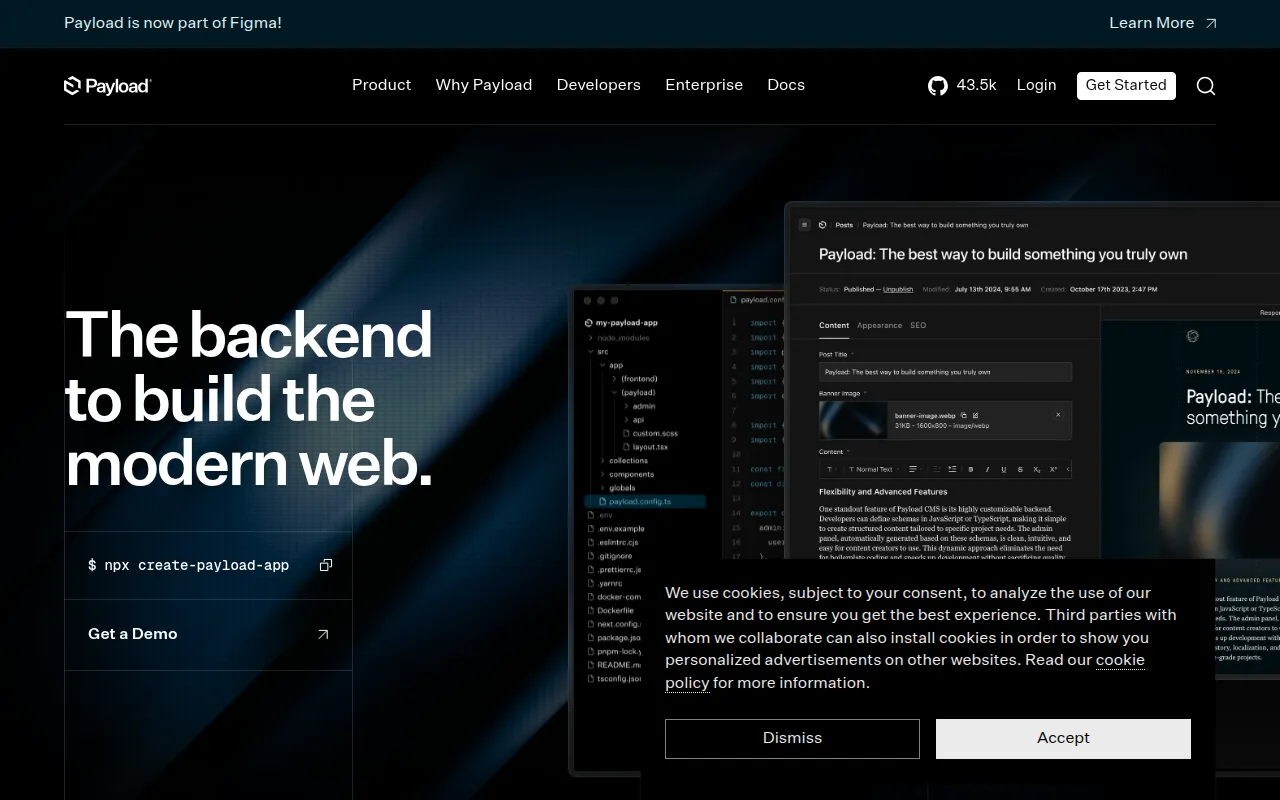
Payload is a Next.js native headless CMS that installs directly inside an existing /app folder rather than running as a separate service, positioning itself as an open source alternative to Contentful and Sanity. Because Payload runs inside the same Next.js application as the frontend, React Server Components can query the database directly instead of making a separate REST or GraphQL request. Both the admin panel and backend are written in TypeScript and are fully extensible, and the project describes itself as the first Next.js native CMS built this way.
Key features
- Native Next.js integration: installs into an existing
/appfolder, so frontend and backend can share the same codebase and deploy target instead of running as separate services. - Direct database queries in Server Components: skip the REST/GraphQL round-trip when rendering server-side, since Payload's data layer is reachable from the same process.
- Authentication out of the box: user accounts, access control, and API tokens are built into the core rather than bolted on as a plugin.
- Versions and drafts: every collection can support content versioning with a draft and publish workflow, plus on-demand revalidation and live preview.
- Localization: fields can be configured for multiple locales without a separate translation layer.
- Lexical rich text editor and block-based layout builder: a configurable content-block system for building flexible page layouts, plus conditional field logic for showing or hiding fields based on other values.
- Document and field-level hooks: run custom logic on any create, read, update, or delete action Payload exposes, for every field and every collection.
Self-hosting and deployment
Payload deploys anywhere Node.js runs, including serverless. One-click templates are available for Cloudflare (Workers, R2 for uploads, and D1 for a globally replicated database) and for Vercel (Next.js frontend, a Neon database, and Vercel Blob for media storage). Both options ship the full stack, database and storage included, without manual infrastructure setup, and Payload notes that authentication relies on HTTP-only cookies and CSRF protection rather than client-exposed tokens.
Getting started
pnpx create-payload-app@latest scaffolds a new project, or npx create-payload-app --example example_name starts from one of the examples in the Examples Directory. The website template (-t website) is the recommended starting point since it demonstrates custom Rich Text blocks, on-demand revalidation, live preview, and a Tailwind-based frontend inside the same /app folder. An ecommerce template is also available for stores that need product catalogs and checkout flows, and community-maintained templates are tagged payload-template on GitHub for discovery. Support channels include GitHub Discussions and Issues, a Discord server, and a documented community-help page for questions that come up during setup.
Payload is completely free and open source, with no vendor lock-in on where it runs. Migrating from version 2 to version 3 is covered by a dedicated migration guide in the repository's docs folder.
Frequently asked questions







Similar to Payload


