
Baserow
Baserow is an open source, no-code platform for building databases, applications, automations, and dashboards, self-hosted or cloud.
 Airtable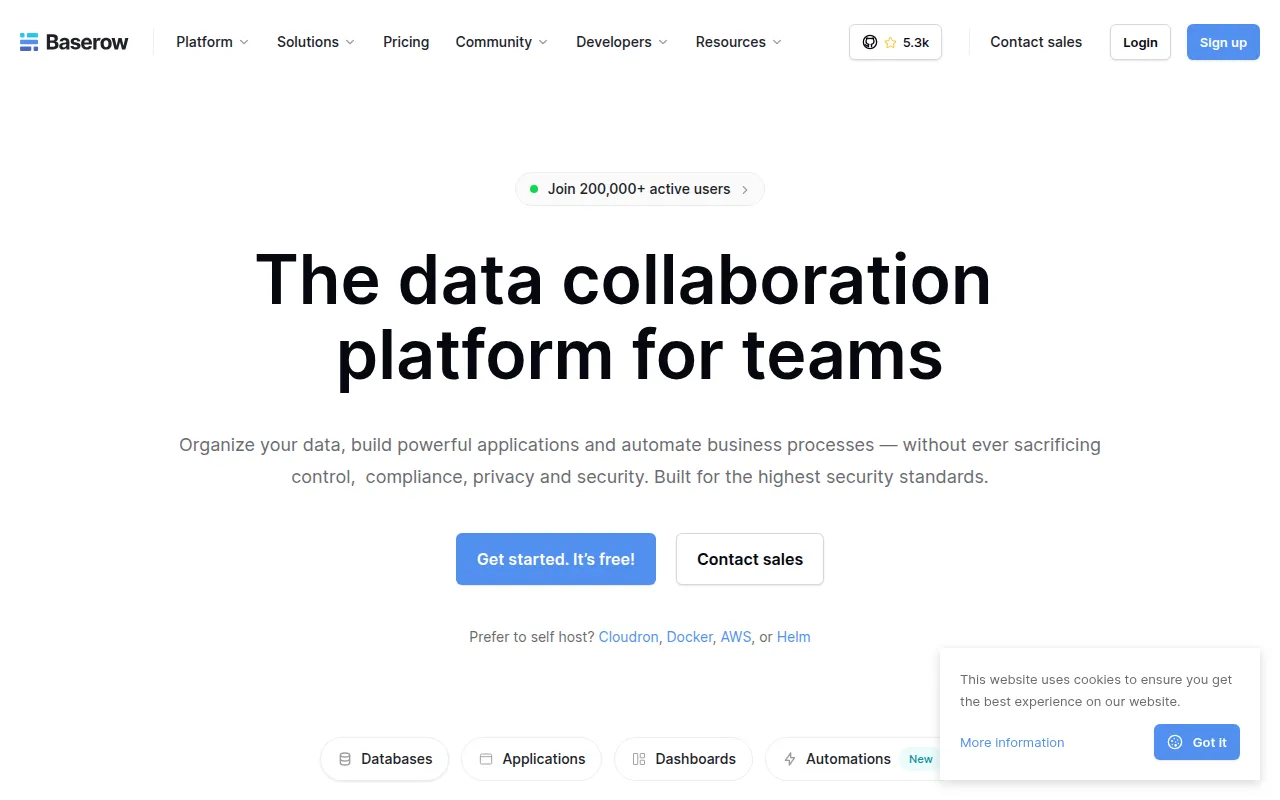
Baserow is an open source, no-code platform for building databases, applications, automations, and AI agents. It combines a spreadsheet-like interface with a relational database underneath, and is positioned directly as an alternative to Airtable for teams that want full data ownership without storage limits or vendor lock-in. The project reports more than 150,000 users and has moved its primary repository from GitLab to GitHub, with issue history migrated but pull request history left on the original GitLab project. It's also described in its own README as GDPR, HIPAA, and SOC 2 Type II compliant, which matters for teams in regulated industries evaluating a no-code database as a system of record rather than just a prototyping tool.
Key features
- Spreadsheet-database hybrid: Familiar grid editing backed by a real relational database.
- Application builder: Build applications and portals and publish them on your own domain.
- Automations: Automate repetitive workflows without writing code.
- Dashboards: Visualize data with built-in dashboard views.
- Kuma AI assistant: A built-in AI assistant that can create databases and workflows from natural language instructions.
- Multiple view types: Includes kanban, form, and other views beyond the default grid.
- Compliance certifications: GDPR, HIPAA, and SOC 2 Type II compliant for teams with regulatory requirements.
- API-first: A headless API sits underneath the interface, so the same data can be read and written by external systems, not only through the UI.
Self-hosting and deployment
Baserow is easily self-hosted with no storage restrictions, and ships as a single Docker image (docker run -v baserow_data:/baserow/data -p 80:80 -p 443:443 baserow/baserow). Helm charts and Docker Compose files are also provided for more involved deployments, alongside documented install paths for Heroku, Render, Digital Ocean, AWS, Cloudron, Railway, and Elestio. A managed cloud option is available at baserow.io for teams that want to start immediately without running infrastructure themselves. Community support runs through a dedicated forum at community.baserow.io, separate from the GitHub issue tracker used for bug reports and feature requests, and a CONTRIBUTING.md file in the repository documents how to get involved beyond just filing issues.
Tech stack
The backend is built with Django and PostgreSQL, and the frontend uses Vue.js. The project is open-core, with non-premium and non-enterprise features MIT licensed for commercial and private use, and a just-based development environment for contributors who want hot reloading while working on the codebase. Full API documentation, including an OpenAPI schema, is published alongside the human-readable docs, so integrations can be built against a machine-readable contract instead of just prose descriptions of each endpoint. Contributors set up the development environment by cloning the repository and running just dc-dev build --parallel followed by just dc-dev up -d, then visiting http://localhost:3000 for a version with hot code reloading enabled.
Frequently asked questions







Similar to Baserow


