
Airbyte
Airbyte is an open source data platform with 600+ connectors for moving data from APIs and databases to warehouses.
 Fivetran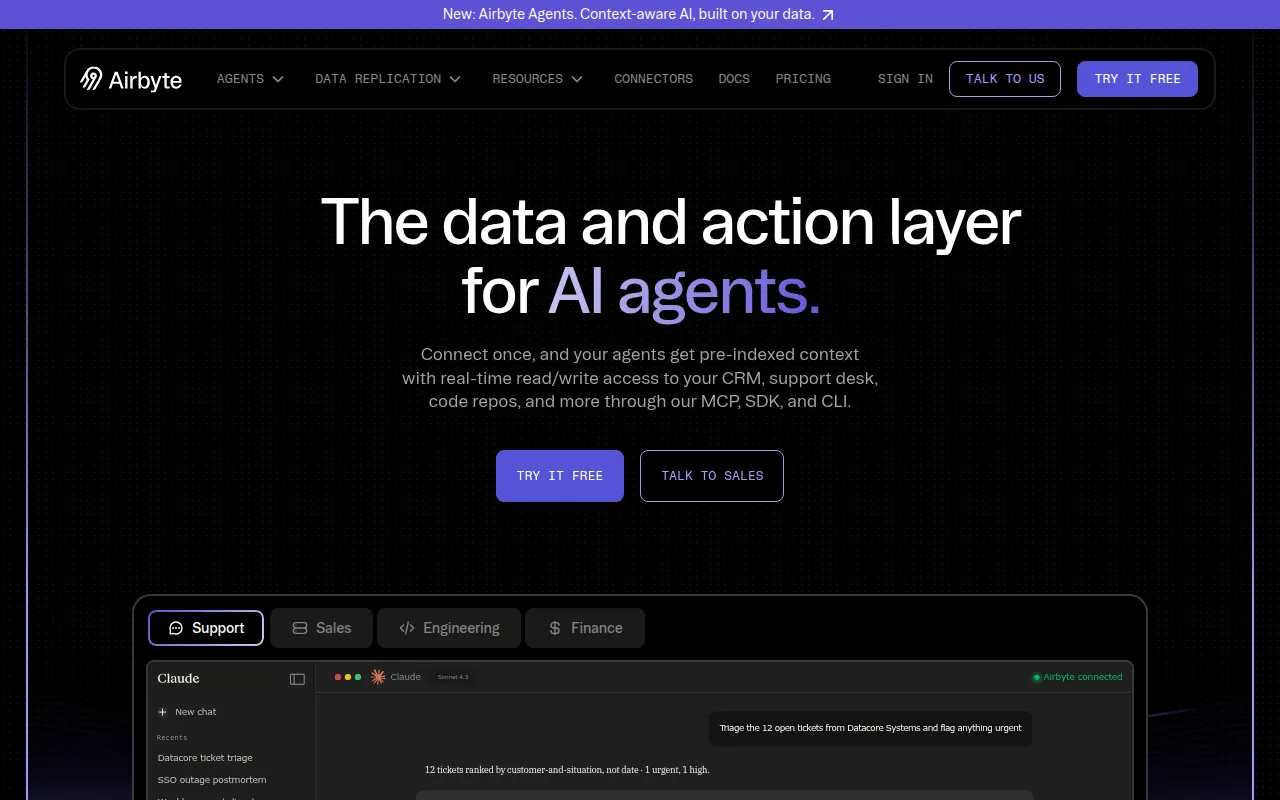
Airbyte is an open source data movement platform for ELT pipelines, syncing data from APIs, databases, and files into warehouses, lakes, and AI applications. It covers the long tail of data sources through a catalog of 600+ connectors, and it's built so data engineers can customize or build new connectors instead of waiting on a vendor. Airbyte positions itself as an open alternative to closed, usage-priced tools like Fivetran, while also offering an Agent SDK for teams that need to expose the same data to AI agents rather than a warehouse.
Key features
- 600+ pre-built connectors: cover APIs, databases, data warehouses, data lakes, and increasingly AI applications, maintained across a large open source contributor base.
- No-code Connector Builder: create a connector for an undocumented or internal API without writing a full integration from scratch.
- Low-code CDK: build more complex connectors with a configuration-based development kit when the no-code builder isn't enough for the source's quirks.
- Orchestrator integrations: trigger and manage Airbyte syncs from Airflow, Dagster, Kestra, or directly through the Airbyte API.
- Agent SDK for AI: the open source Agent SDK, installed with
uv pip install airbyte-agent-sdk, turns type-safe connectors into LLM tools, with built-in retry, exception translation, and output-size guardrails, compatible with pydantic-ai, LangChain, OpenAI Agents, and FastMCP. - Airbyte Cloud and Enterprise options: the same connector catalog is available as a managed cloud service or an enterprise-licensed self-hosted deployment with added security features.
Ideal use cases
Data teams centralizing scattered SaaS and database sources into a warehouse like Snowflake or BigQuery use Airbyte instead of maintaining custom extraction scripts for each API. Teams building AI agents that need live access to CRM, support, or product data reach for the Agent SDK instead, since it wraps the same connector catalog as type-safe tools rather than syncing everything into a warehouse first.
Self-hosting and deployment
Airbyte Open Source is deployed by following the official quickstart guide, and syncs can be orchestrated through Airflow, Dagster, Kestra, or the Airbyte API once running. A hosted demo app lets you explore the connector catalog and sync UI without deploying anything, and a public connector registry report lists every connector currently available across Airbyte and Airbyte Cloud.
Contributing and community
Bug reports and feature requests go through GitHub issues, and the project maintains a list of contributor-program issues tagged as good first issues for newcomers. The wider community gathers in the Airbyte Community Slack and the Airbyte Forum for questions, and the roadmap is published publicly on GitHub Projects.
Tech stack
The core platform is dual-licensed under MIT and Elastic License v2, depending on the connector, and is built primarily in Java and Python across the platform and connector codebases, with connector-specific code spanning additional languages where needed.
Tags:
Frequently asked questions







Similar to Airbyte


